
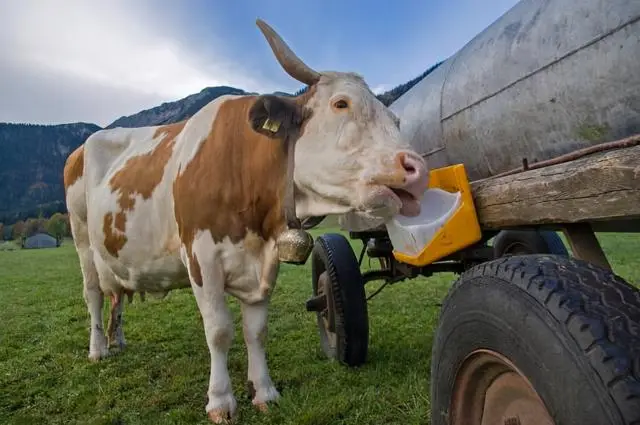
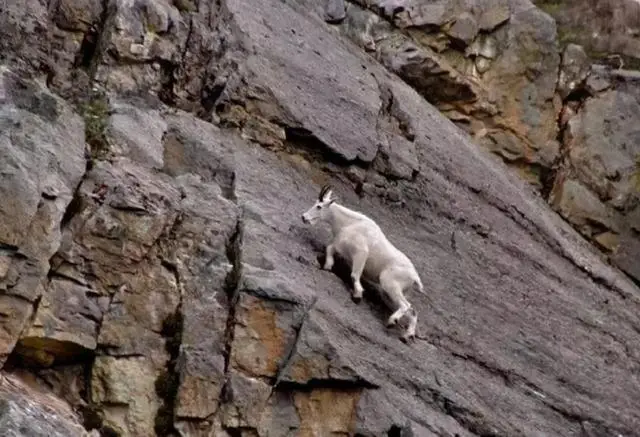
A deer presses its mouth against a roadside barrier. A wild goat climbs an almost vertical concrete dam as if gravity has briefly lost meaning. Cattle gather around salt blocks with a focus that feels strangely intentional, as if they are responding to something humans cannot see or hear.
To an outside observer, these moments can appear almost irrational, as though animals are randomly interacting with objects in their environment. But nothing about it is random. What’s really happening is far more fundamental, and it begins with something so ordinary that it is often overlooked: salt.
Salt is not just a taste preference or a dietary detail. It is one of the invisible forces that quietly governs biological stability. And across nearly all land animals, from domesticated livestock to fully wild species, there exists a persistent attraction to it that is not learned, but inherited through deep evolutionary memory.
A Hidden Requirement Written Into Biology
The need for salt is not a cultural behavior and it is not unique to humans. It is embedded into the way animal bodies function at the most basic level.
Inside every nerve signal, every muscle contraction, every exchange of fluid between cells, there is a constant movement of charged particles. Among them, sodium plays a central role. Without it, electrical signaling in the body begins to break down, muscles lose coordination, and internal balance becomes unstable in ways that quickly affect survival.
But animals do not “understand” this process. There is no internal explanation, no concept of chemistry, no awareness of sodium ions or electrolyte gradients. Instead, what exists is a simpler and older mechanism: attraction and avoidance shaped by need.
This is why salt does not appear to them as “salt.” It appears as behavior-triggering significance. A surface with sodium residue becomes interesting. A mineral-rich patch of soil becomes worth revisiting. Even traces left on sweat, skin, or animal fur can become meaningful cues.
What humans interpret as curiosity is actually something closer to biological urgency expressed through movement.
Salt Licks and the Language of Maintenance
In agricultural environments, this hidden need becomes easier to observe. Farmers have long provided salt blocks, often called salt licks, placed in fields or enclosures where livestock can access them freely.
Cows, sheep, and horses return to these blocks repeatedly, not out of habit in the human sense, but because their internal systems regulate demand continuously. When mineral balance shifts even slightly, behavior adjusts.
Over time, animals that lack access to sufficient salt begin to show subtle but noticeable changes. Energy drops. Appetite weakens. Movement becomes less responsive. These are not dramatic failures, but slow drift away from optimal function.
The salt lick, in this context, is not enrichment. It is maintenance infrastructure. A stable point in the environment that allows a biological system to keep itself aligned.
What is striking is not that animals seek salt, but that they seek it with such consistency, across species and environments that share no direct connection except the underlying architecture of life itself.
When the Environment Becomes a Salt Map
In wild settings, salt is rarely evenly distributed. It concentrates in certain geological formations, soil compositions, and even along surfaces influenced by human activity.
Road salt in colder regions, mineral deposits exposed by erosion, and residues left behind by biological activity all create small but significant “zones of interest” for animals that can detect them through sensation rather than thought.
This is where behavior begins to look almost strange to human eyes. Animals may gather around places that seem irrelevant to survival at first glance. They may return to the same unusual surfaces repeatedly. In some cases, they interact with objects that have no obvious connection to food or water.
But from their perspective, these are not arbitrary locations. They are points where the chemistry of the environment briefly aligns with internal demand.
The world, in this sense, is not a landscape of objects. It is a shifting map of chemical signals.
The Human Body as a Moving Mineral Source
One of the more surprising extensions of this behavior appears in the way animals sometimes respond to humans.
Sweat contains sodium. Skin retains traces of it. Even after movement and evaporation, small amounts remain accessible on the surface. To an animal sensitive to mineral cues, a human body can register not as a person in the social sense, but as a mobile source of salt.
This is why insects gather around sweat. Why livestock may show unusual interest in human skin under certain conditions. And why, in some situations, animals seem drawn to humans in ways that feel misinterpreted as affection or aggression.
In reality, it is neither. It is simply chemistry being read through instinct.
Water Without Balance Is Not Enough
Salt’s importance becomes even clearer when considering hydration.
Water alone does not resolve internal balance. In fact, without electrolytes like sodium, fluid regulation becomes unstable. The body must maintain precise ratios to ensure that water moves correctly between cells and tissues.
This is why animals, especially those in extreme environments, rarely rely on water alone. Camels, for example, operate under tightly regulated internal systems where salt and water intake are deeply connected. The goal is not just to absorb water, but to maintain stability while doing so.
Even in humans, the same principle appears after exertion. Drinking only water after heavy sweating does not fully restore balance; the system requires both fluid and minerals to reset properly.
An Ancient System Still Running Beneath Modern Life
The dependence on salt is not a modern adaptation. It is a remnant of an ancient biological history that predates land itself.
Early life evolved in ocean environments where mineral balance was naturally maintained by surrounding water. As organisms transitioned onto land, they carried this internal chemistry with them. Instead of abandoning it, evolution preserved it.
That is why sodium gradients still drive nerve activity. Why cellular membranes still depend on ion exchange. Why even the most complex mammals still rely on a system that originally evolved in a completely different environment.
In a very real sense, every land animal is still partially structured around an internal version of seawater.
What the Persistence of Salt Really Suggests
When viewed through this lens, the behavior of animals around salt is no longer strange. It is consistent, predictable, and deeply rooted in the architecture of life.
What seems like attraction is actually regulation. What looks like curiosity is maintenance. And what appears to be randomness is, in fact, a response to one of the oldest requirements in biology.
Salt is not a preference. It is a constraint.
And perhaps the most interesting implication is this: if there were ever a form of life that did not depend on electrolytes at all, it would not simply be a variation of what we already know. It would represent a fundamentally different biological logic—one that does not appear anywhere in the current story of life on Earth.
For now, though, every animal we see is still quietly governed by the same invisible rule.
The need to stay in balance with salt.
How Do Marine Animals Drink Water? Understanding Osmosis in the Ocean