

We’ve all heard the old poem: “Water, water, everywhere, nor any drop to drink.” For a human stranded at sea, drinking the ocean is a death sentence. But for the billions of creatures living in it, “drinking the salt” is just a Tuesday.
Have you ever stopped to wonder: How do marine animals drink water? Why don’t they just shrivel up like raisins in that salty brine?
The answer involves a high-stakes game of biological physics, a bit of “internal plumbing,” and—in the case of sharks—a very stinky secret. Here is how osmosis in marine animals works and why they can do what we can’t.
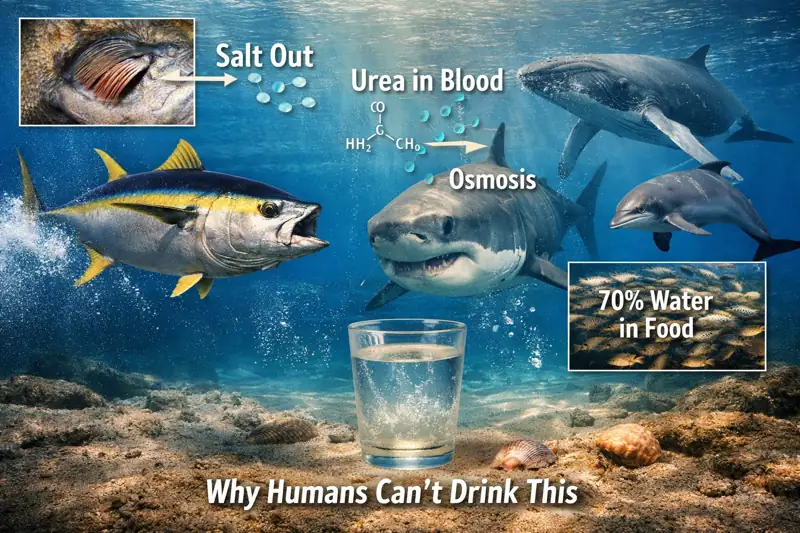
The Invisible Tug-of-War: Osmotic Pressure
To understand why the ocean is “dangerous” to drink, we have to talk about osmotic pressure.
Think of water molecules as the ultimate “fickle friends.” They hate being alone; they always want to hang out where the party is loudest—and in the ocean, the “party” is the salt. Through a process called osmosis, water naturally moves from areas of low salt concentration (like a fish’s body) to areas of high salt concentration (the ocean).
For most marine vertebrates, their internal salt level is about 1%, while the ocean sits at a whopping 3.5%. This means the ocean is constantly trying to “suck” the water right out of their cells. If these animals didn’t have a plan, they’d be dehydrated to death while surrounded by water.
Strategy 1: The “Gulp and Pump” (Bony Fish)
Most of the fish you know—like Tuna or Cod—use a brute-force method. Their strategy is simple: Since the ocean is stealing my water, I’ll just drink more of it.
But wait, isn’t drinking seawater suicidal? For us, yes. For them, they have a “cheat code” located in their gills: Mitochondria-rich cells (often called chloride cells).
These cells act like high-tech ion pumps. When the fish swallows seawater, the intestines absorb the water and the salt. Then, these specialized gill cells work overtime to physically pump the excess salt back into the ocean against the concentration gradient.
It’s an energy-intensive process—basically “burning fuel” to stay hydrated—but it keeps them alive.
Strategy 2: The “Urine Hack” (Sharks and Rays)
Sharks and rays (cartilaginous fish) looked at the osmosis problem and decided on a much weirder solution. Instead of fighting the salt, they decided to become saltier.
Well, technically, they become “denser.” Sharks retain high levels of urea (a metabolic waste product) in their blood. By packing their tissues with urea and other chemicals, they raise their internal “concentration” until it is slightly higher than the seawater around them.
Because of this, water doesn’t leak out of the shark; it actually osmotes INTO the shark through their skin and gills automatically. They don’t even need to “drink” in the traditional sense.
Pro tip: This is also why shark meat can have a faint smell of ammonia or urine if it isn’t prepared correctly. You’re literally eating their hydration strategy!
Strategy 3: The “Food as a Canteen” (Whales and Dolphins)
What about the heavy hitters like whales and dolphins? These are mammals, just like us. Their kidneys are strong, but they aren’t “seawater desalination plants.”
Marine mammals mostly avoid drinking seawater altogether. Instead, they get their hydration from their diet.
- Juicy Prey: A fish is roughly 70% to 80% water. When a whale eats a ton of fish, it’s also “drinking” hundreds of liters of fresh water stored in the fish’s tissues.
- Metabolic Water: Marine mammals are masters at breaking down fat (blubber). When the body metabolizes fat, one of the byproducts is actually water.
Essentially, they carry their own water reservoirs inside their fat cells.
Why Can’t Humans Drink Seawater?
So, why can’t we just “tough it out” like a tuna? It comes down to our kidneys.
The human kidney is like a single-core processor trying to run a 2026 AAA video game—it just doesn’t have the bandwidth. Our kidneys can only produce urine that is about 2% salt.
If you drink a cup of 3.5% salt seawater, your body has to find a way to get rid of that salt. To flush out the salt from that one cup, your body needs to create about a cup and a half of urine. You end up losing more water than you drank. It’s a mathematical spiral toward total dehydration.
In short: The more you drink, the thirstier you get, until your system eventually shuts down.
The Bottom Line
Solving the “drinking problem” in the ocean is a billion-year-old arms race. Whether it’s the high-energy ion pumps of a tuna, the urea-soaked blood of a shark, or the metabolic “fat-to-water” trick of a whale, nature has found ingenious ways to thrive in a salty world.
The next time you’re at the beach and get a direct hit of seawater in the face, just remember: you’re not built for this, but the fish are literally “pumping” for their lives!
Further Reading:
Crows, Rabbits, Polar Bears, and Snails: Nature’s Most Mind-Blowing “Superpowered” Animals