
Imagine plunging our planet into an endless freeze—not just winter cold, but a descent toward the ultimate cosmic chill: absolute zero. As temperatures drop degree by degree, familiar matter undergoes strange phase transitions in bizarre, terrifying, and wondrous ways. Water defies logic, gases become exotic liquids, and physics itself begins to unravel into quantum physics magic.
Join this immersive voyage into the coldest frontiers of the universe. Every ten-degree plunge unlocks phenomena that challenge everything you thought you knew about temperature, life, and reality itself.
The Strange Power of Freezing Water: Life at 0°C
We begin with something deceptively ordinary: water. At 0°C (32°F) under standard atmospheric pressure, water freezes into ice. But here’s the twist that protects life on Earth—ice is less dense than liquid water.
Ice molecules arrange into a beautiful, open hexagonal crystal lattice with plenty of empty space. That’s why ice floats. If it didn’t, lakes and oceans would freeze from the bottom up. Entire bodies of water could turn into solid blocks of ice, wiping out aquatic life. Floating ice acts like a protective blanket, providing a cryogenic shield that allows life to persist even in the harshest freezes.
Sea Ice Forms – Nature’s Insulating Shield
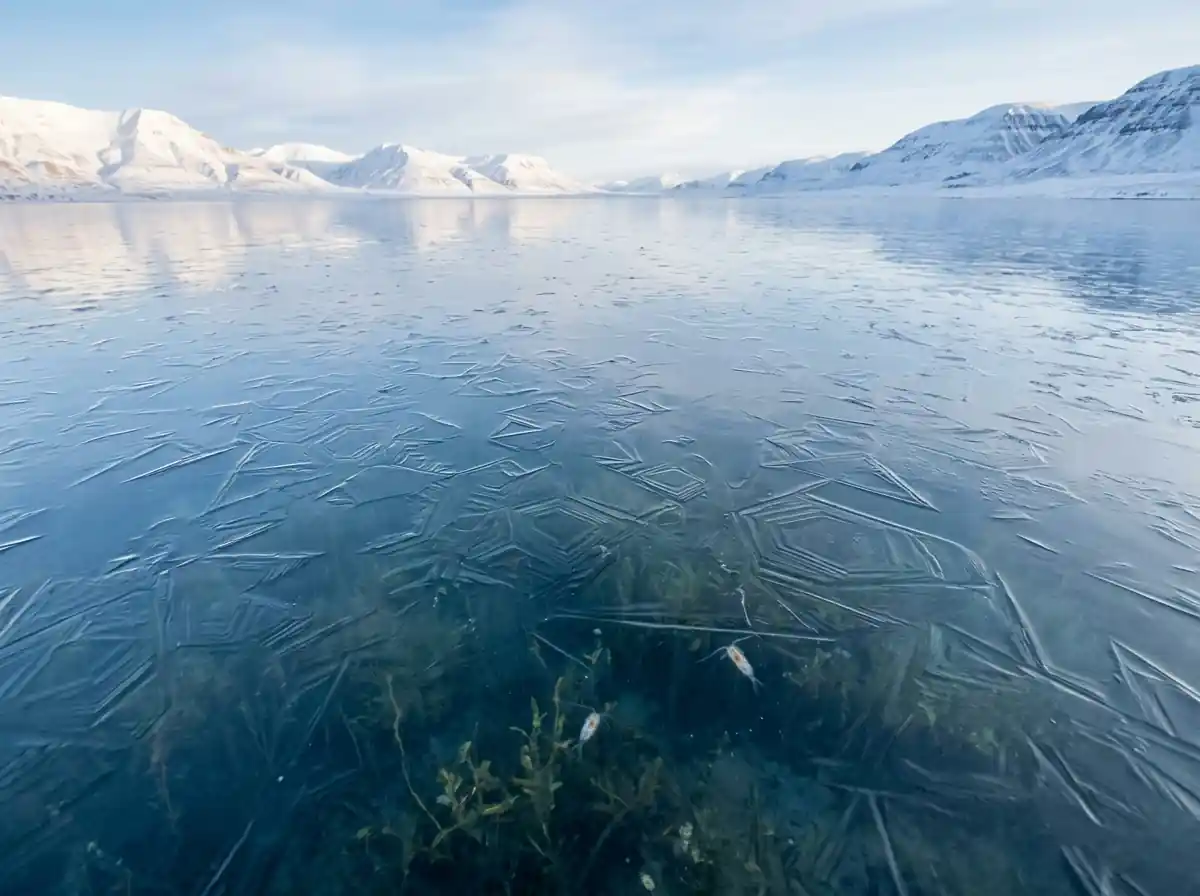
Drop the temperature to around -1.8°C (28.8°F), and seawater begins its transition. Tiny ice crystals form on the surface of the Arctic and Antarctic oceans. They don’t sink. Instead, they cluster together, creating a thin but resilient layer of sea ice—like a natural quilt that shields the liquid water beneath from even colder air. This delicate balance keeps polar oceans from becoming lifeless tombs.
The Screaming Snow at -20°C
At -20°C (-4°F), snow underfoot starts to “scream.” The sound comes from trapped air pockets in the snow crystals being crushed and released as you walk. It’s a sharp, eerie crunch—like popping thousands of tiny bubble wraps at once. Animals sense the deepening cold. Plant sap thickens and slows. Many creatures enter hibernation as their blood grows more viscous. One wrong step further, and ice crystals forming inside cells could rupture membranes like microscopic daggers—fatal for most life forms.
The Mpemba Effect Paradox: Rapid Freezing at -25°C
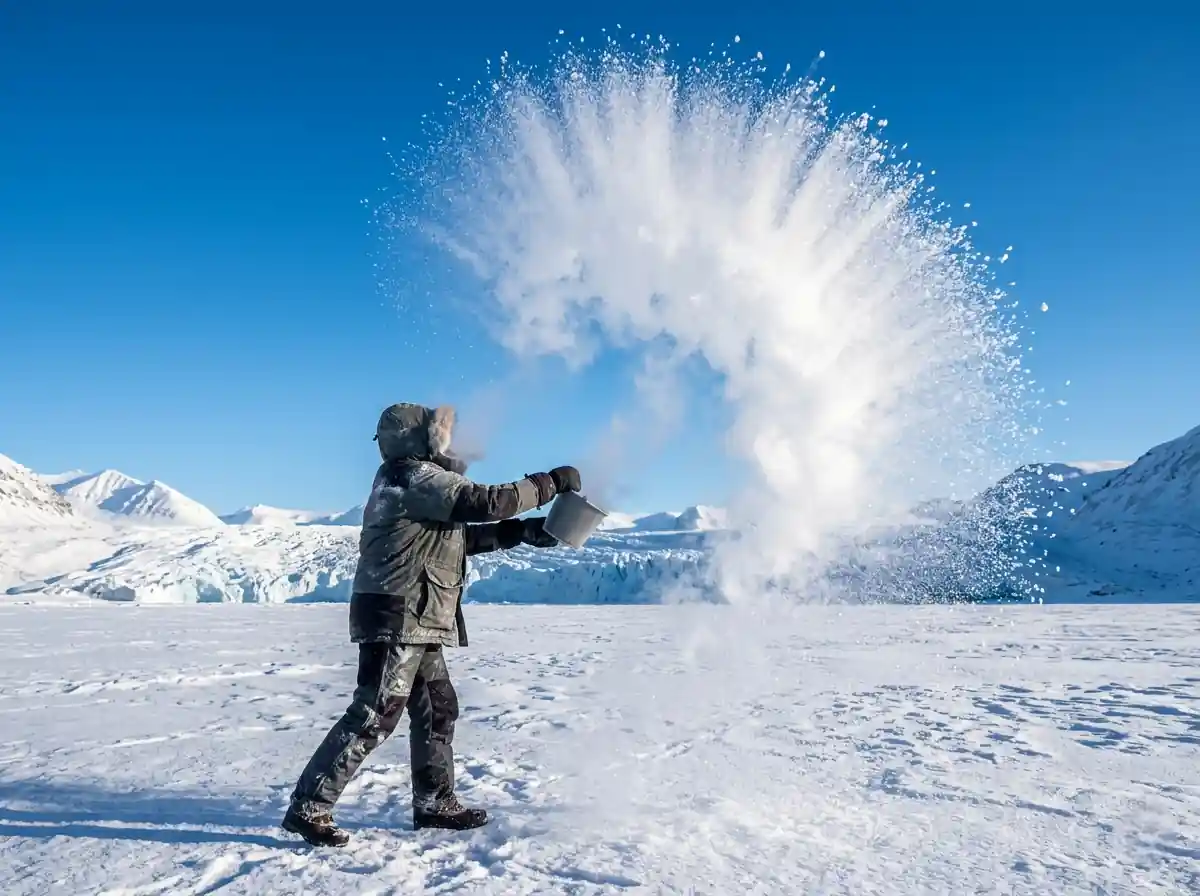
Here’s a mind-bending paradox at around -25°C (-13°F): hot water can freeze faster than cold water under certain conditions, known as the Mpemba effect. Toss boiling water into the frigid air, and it can erupt into a spectacular cloud of instantly forming ice crystals. While thermal motion and evaporation play roles, the visual drama remains one of the most counterintuitive sights in nature.
Brittle Steel and Instant Ice Spittle at -40°C
At -40°C (-40°F), everyday objects turn treacherous. Spit hits the ground and freezes before it lands. Steel, usually tough and ductile, becomes as brittle as glass—a gentle tap can shatter it like a cookie. Machinery fails. Human survival without specialized cryogenic protection becomes nearly impossible.
Solid Carbon Dioxide: Dry Ice at -78.5°C
When temperatures hit -78.5°C (-109.3°F), carbon dioxide skips the liquid phase entirely and turns straight into solid dry ice. It doesn’t melt; it sublimates directly back into gas, creating thick, eerie fog. On Mars, where the atmosphere is 95% CO₂, polar winters produce vast dry ice caps that grow and shrink with the seasons—a dramatic display of planetary breathing.
Earth’s record natural low, measured at Vostok Station in Antarctica, is -89.2°C (-128.6°F). Without gear, skin freezes instantly and blood thickens toward solidity. It’s a glimpse of hell frozen over.
Atmospheric Collapse: The Great Gas Liquefaction Parade
As we plunge deeper into the cryogenic realm, the air itself begins to collapse as gases reach their boiling points:
- Around -108°C: Xenon liquefies.
- -153°C: Krypton turns liquid.
- -161.5°C: Methane condenses—forming the hydrocarbon lakes and rivers we see on Saturn’s moon Titan.
- -182.9°C: Oxygen becomes a pale blue liquid that clings mysteriously to container walls, like a glowing spectral ghost.
- -195.8°C: Nitrogen, the most abundant gas in our air, turns into liquid nitrogen—the ultimate laboratory coolant used to flash-freeze biological samples and fuel dreams of cryogenic human suspension.
Helium’s Defiant Reign and Superfluid Magic
Only one element laughs in the face of this cold: Helium. It remains a gas until an astonishing -268.9°C (4.2 K). Below that, helium transforms into a liquid that refuses to freeze at normal pressure—no matter how close you get to absolute zero.
Cool it further to about 2.17 K, and something truly otherworldly happens: Superfluid Helium (Helium II) emerges. This fluid has zero viscosity. It crawls up container walls and escapes through impossibly tiny pores. Pour it into a spinning bucket, and it keeps rotating forever. Its thermal conductivity is hundreds of times better than copper, a true quantum mechanics marvel that feels like magic leaking into our reality.
Approaching Absolute Zero: Where Physics Breaks
As we near absolute zero (-273.15°C or 0 K), classical physics surrenders. Particles’ thermal motion nearly stops, but they never quite reach perfect stillness. The third law of thermodynamics says you can’t reach absolute zero in a finite number of steps—there’s always a little heat left to extract.
Zero-point energy ensures atoms retain faint quantum vibrations. Even in the coldest void, quantum fluctuations in the vacuum create subtle radiation. True darkness and perfect silence may be illusions; a faint whisper of activity always remains. Helium stays liquid because of these quantum effects, making it the only element that never solidifies at atmospheric pressure.
A New Understanding of Cold
From water’s life-saving float to screaming snow, and from ghostly liquid oxygen to wall-climbing superfluids, cooling toward absolute zero reveals a universe far stranger than our senses can grasp.
We can approach the coldest limit, but never truly arrive. In that unreachable realm, the ordinary becomes extraordinary, and the laws we take for granted dissolve into quantum wonder. The journey into the cold has only just begun.
Further Reading:If All Sunlight Hit One Person: Earth’s Doomsday Rhapsody