

Ice, one of the most common and abundant substances on Earth, seems to have been thoroughly understood by humanity. However, a recent study published in Nature Physics has made a surprising new physics discovery: Flexoelectricity in ice! This revelation, proving ice generates electricity when it is bent, uncovers a hidden “superpower” in the solid form of water, not only expanding our knowledge of material properties but also offering a critical new clue to the long-standing mystery of the lightning formation mechanism.
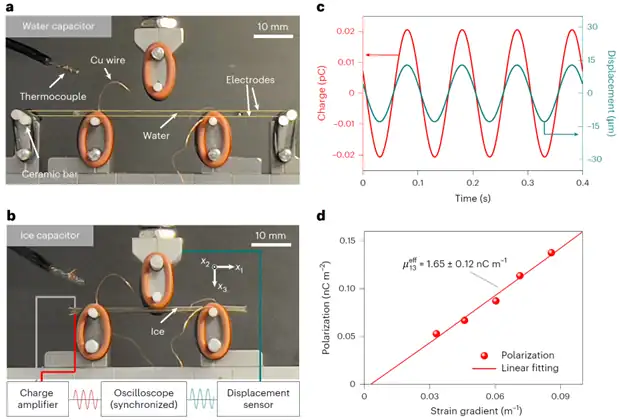
I. Flexoelectricity: The Hidden Generator in Ice
The core of this new finding lies in a fascinating phenomenon called Flexoelectricity. While the term sounds technical, the Flexoelectricity Principle can be simply understood as: when a material undergoes non-uniform deformation (like bending or twisting), it causes an internal separation of electric charges, resulting in a voltage.
Researchers have now confirmed that Flexoelectricity in ice is universally present. Under any temperature below 0°C, ordinary ice (hexagonal ice, or Ice Ih) generates an electric charge when subjected to mechanical stress. Even more intriguing, at the extremely low temperature of -113°C, a thin ferroelectric layer forms on the surface of the ice.
This means ice possesses a unique dual power potential:
- Flexoelectricity at “Warm” Temperatures (up to 0°C): Charge separation triggered by non-uniform deformation (bending).
- Ferroelectricity at Extreme Cold: Charge generation from the properties of the surface layer.
This discovery grants ice similar application potential to electro-ceramic materials like TiO₂. It is highly promising for use in flexible electronics, micro-sensors, and pioneering new energy harvesting technology.
II. Solving the Lightning Riddle: The Mechanism of Charge Separation
Beyond its application prospects, the study holds immense importance by potentially solving a natural puzzle that has baffled scientists for centuries: How is lightning formed?
We know that lightning occurs when ice particles collide within thunderclouds, building up a massive electric potential that is then released. The traditional challenge has been this: ice particles lack piezoelectricity, meaning they cannot generate a charge through simple compression or uniform deformation. Therefore, the exact mechanism by which collisions efficiently separate charges to form the required strong electric field has remained a mystery.
The new research offers a compelling explanation:
- The study measured the electric potential generated by a piece of ice when it was bent.
- The results were strikingly consistent with field observations of charge accumulation during ice particle collisions in thunderstorms.
This consistency strongly suggests that Flexoelectricity in ice is a crucial source for the electric potential buildup in thunderclouds. In the turbulent environment of a storm, ice crystals, snow, and graupel collide, and these collisions are inevitably accompanied by non-uniform deformation and bending, allowing ice generates electricity to efficiently separate and accumulate charges.
III. A “Clueless” Exploration: The Unending Mysteries of Nature
As you reflected, this new physics discovery highlights the limits of human knowledge. Despite having explored space and deciphered the atom’s secrets, the microscopic charge mechanism of water—the most common substance around us—and common natural phenomena like lightning, is only now finding a definitive explanation.
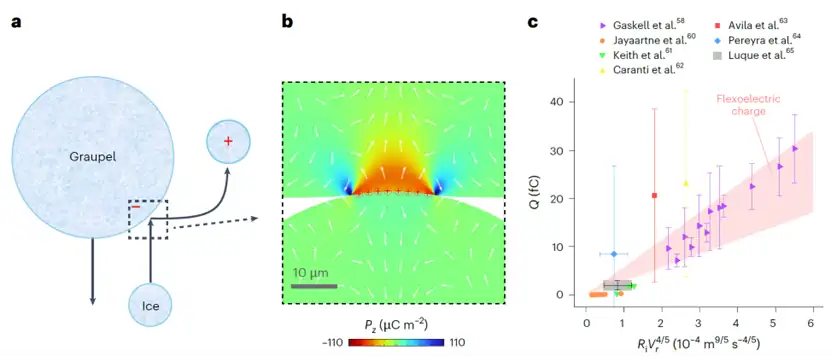
The discovery of flexoelectricity adds a previously overlooked physical dimension to the complex charge separation process. It proves, once again, that even in our most familiar domains, nature is full of unknowns, waiting to be explored.
In the future, researchers hope to utilize Flexoelectricity in ice for practical applications and, more importantly, to fully understand the mechanism of lightning, pushing the boundaries of energy harvesting technology forward.
IV. Paving the Way for Ice-Based Technologies
The discovery of Flexoelectricity in ice opens up novel avenues for material science. Scientists envision self-powered devices for extreme environments, such as cryo-sensors for polar exploration or space missions. Utilizing this principle, tiny, energy-efficient generators could be designed. Furthermore, the strong link between flexoelectricity and the physics of water suggests a broader re-evaluation is needed for other common hydrogen-bonded materials, potentially revealing new forms of sustainable energy harvesting technology previously thought impossible. The next step involves engineering stable interfaces to effectively capture and transmit the electricity generated from the bending stress.
Continue Exploring Physics
Related Article: Can You Really Dodge a Bullet by Jumping into Water? Science Says Yes—With Conditions