

In science fiction novels, we often imagine how alien civilizations might detect traces of humanity through space telescopes or archaeological ruins. But if humanity were to suddenly go extinct, could future civilizations—whether successor species on Earth or visiting extraterrestrials—easily discern that we once existed? The answer might be more disheartening than you think: it’s highly unlikely. This isn’t just due to the relentless passage of time, but more profoundly, because of the immense destructive power of geological forces. Even more astonishingly, before humans appeared, has this ancient blue planet already nurtured other intelligent civilizations? This question has sparked intense debate in the scientific community, centered on the famous “Silurian Hypothesis.” This hypothesis boldly posits that Earth may have hosted one or more industrial civilizations prior to humanity, and that their traces have now been completely erased. Today, let’s delve into this mystery, from the absence of geological evidence to humanity’s own potential “invisible” fate.
The Silurian Hypothesis: A Bold Conjecture
The Silurian Hypothesis was proposed in 2018 by two American scientists—Adam Frank and Gavin Schmidt—inspired by the “Silurian” episode of the British sci-fi series Doctor Who. Far from baseless speculation, the hypothesis rests on two key scientific observations. First, Earth’s history of life is far too long for humanity’s existence to seem anything but insignificant.
Life on Earth originated around 4.3 billion years ago in the Archean Eon, while modern Homo sapiens have only existed for about 300,000 years. Agricultural civilizations emerged around 10,000 years ago, and the Industrial Revolution has lasted a mere 300 years. On the vast geological timescale, human civilization is but a fleeting moment, like a blink of an eye. Consider this: over 4.3 billion years, Earth has witnessed countless cycles of species rise and fall. Why couldn’t other intelligent species have emerged, developed industry, and quietly vanished in some era? For instance, the early mammalian age or the recovery period after the dinosaur extinction could have provided ample opportunity for the evolution of intelligent life. The hypothesis suggests that these “prehistoric civilizations” might have completed a full lifecycle— from primitive societies to technological peaks, and then inevitable collapse—millions or even billions of years ago.
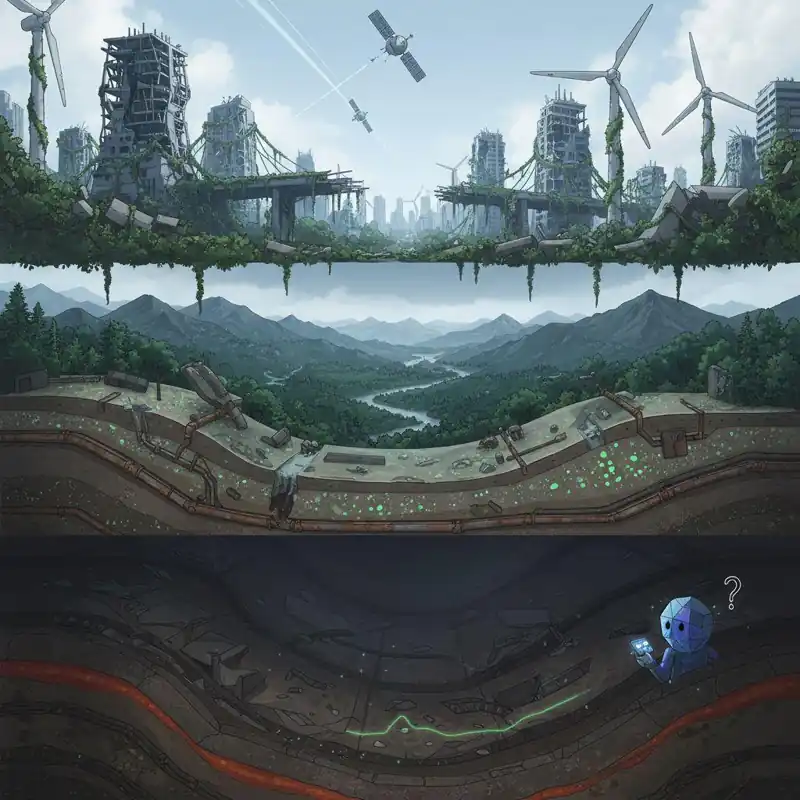
Second, a peculiar ancient geological event provides indirect evidence for this hypothesis. Approximately 56 million years ago, Earth underwent the “Paleocene-Eocene Thermal Maximum” (PETM), a global climate anomaly that lasted about 20,000 years. During this period, global temperatures rose sharply by 5 to 8 degrees Celsius, oceans acidified, carbon cycles were disrupted, and even elements like strontium and molybdenum showed anomalous abundances. Most strikingly, the rock layers record an unusual shift in carbon isotopes (δ¹³C)—a sharp increase in the proportion of light carbon isotopes (¹²C)—which bears a striking resemblance to the carbon emissions from burning fossil fuels. These features are eerily consistent with the environmental impacts of contemporary human industrial activities: greenhouse gas emissions causing global warming, marine ecological collapse, and the injection of anthropogenic carbon into the atmosphere.
Scientists initially attributed the PETM to natural processes, such as massive volcanic eruptions (e.g., activity in the North Atlantic Igneous Province) or the large-scale release of methane hydrates. But the Silurian Hypothesis offers a radical alternative: perhaps it was a “climate catastrophe” triggered by a prehistoric industrial civilization. If an advanced civilization had massively extracted fossil fuels and emitted pollutants millions of years ago, their environmental footprint could perfectly align with the PETM. This isn’t mere coincidence; it’s a historical mirror to humanity’s current crisis.
The Absence of Evidence: The Relentless Erasure of Geological Time
Despite its intriguing premise, confirming the existence of prehistoric civilizations requires finding irrefutable “artificial traces” in the geological strata—such as synthetic compounds, anomalous radioactive isotopes, or tools exceeding the evolutionary capabilities of the time. Yet reality falls short. On geological timescales, traces of any industrial civilization are exceedingly prone to erasure. This is the primary challenge facing the Silurian Hypothesis.
First, Earth’s surface “record book”—its rock layers—renews itself with alarming speed. Currently, the oldest large-scale exposed geological outcrops on Earth date back only about 1.8 million years. What happened to older surfaces? They were either weathered and eroded into dust, subducted into the Earth’s depths via plate tectonics (such as in subduction zones), or buried under glaciers, oceans, or deserts. Plate tectonics is the core of Earth’s dynamism: continents drift several centimeters per year, ancient rocks are compressed, melted, and recycled. Over billions of years, these processes are sufficient to completely “consume” any surface remnants.
Second, even if certain traces miraculously survive, the probability of fossilization is minuscule. In every few hundred thousand years of Earth’s history, the fossil record that remains intact is sparse. Biodegradation rapidly breaks down organic materials: plastic products might decompose within centuries via microbes; metals and stone structures could erode through weathering in mere millennia. Only massive structures, like the Egyptian pyramids, might endure for hundreds of thousands of years. But pyramids are not eternal—earthquakes, sandstorms, and rising sea levels will eventually reduce them to rubble. For even older civilizations (such as those from tens of millions or billions of years ago), the immense destructive forces of plate collisions, glacial advances, volcanic eruptions, and earthquakes continuously reshape the surface, rendering traces unrecognizable.
Researchers have further validated this through computer simulations. They assumed an industrial civilization existed millions of years ago and calculated the decay rates of its traces (such as plastic microparticles, nuclear waste, or urban ruins) under geological processes. The results indicate: even a civilization on the scale of humanity would likely see its footprint concealed or misidentified as a natural phenomenon. For example, the PETM event is still widely regarded by mainstream science as the result of volcanic activity, not anthropogenic intervention. If a civilization’s duration is short (like humanity’s current 300-year industrial history), its trace intensity may not distinguish it from major natural events (such as asteroid impacts or supervolcanic eruptions). This explains why we haven’t detected any “anomalies”: synthetic compounds like chlorofluorocarbons (CFCs) or polystyrene would fully degrade on deep-time scales; radioactive signatures (like carbon-14 spikes) would decay into background noise.
The Scientific Consensus: Absence of Evidence Is Not Evidence of Absence
To date, the scientific community has found no conclusive evidence of prehistoric intelligent civilizations. Geological records show no artificial compounds, anomalous element distributions, or radioactive anomalies that cannot be explained by natural processes. Fossil records reveal no biological relics (such as early mammals using tools) or artifacts (like smelting residues) that exceed the evolutionary levels of their era. These absences lead many scientists to approach the Silurian Hypothesis with caution, viewing it as a thought experiment rather than a serious proposition.
However, one core principle of scientific inquiry is that “absence of evidence is not evidence of absence.” Our exploration of Earth remains far from complete: the deep-sea floors, mantle depths, remote deserts, and beneath glaciers still hold vast uncharted territories. In the future, advances in deep-drilling projects (such as the International Continental Scientific Drilling Program) and sophisticated remote sensing technologies might uncover new clues. For now, the puzzle endures: Has Earth nurtured other intelligent civilizations? The answer remains unknown.
Reflecting on Humanity: How Will We “Vanish”?
Turning our gaze to the present, this hypothesis serves as a stark warning. If humanity were to go extinct now, future civilizations would face the same quandary. Our plastic waste, nuclear refuse, and skyscrapers are equally fragile on geological timescales. Millions of years from now, satellite debris will incinerate upon re-entry into the atmosphere; smartphones and data centers will corrode into indistinguishable mineral grains; even the Great Wall or Eiffel Tower will crumble under plate movements into dust.
Only a few traces—such as the Apollo footprints on the Moon or trace fluorides in the atmosphere—might persist longer, but they too could be misinterpreted as natural variations. The Silurian Hypothesis isn’t merely speculative paleoarchaeology; it reminds us that the rise and fall of intelligent civilizations are routine in Earth’s history, with geological forces as the ultimate “editor.” In the 4.3-billion-year chronicle of this planet, humanity is but a brief chapter. Perhaps this is the profound lesson of our current environmental crisis: if we don’t alter our course, our “industrial signature” will fade into oblivion just like those of any prehistoric civilizations—silently dissolving into the torrent of time. Future explorers—if any—might gaze upon the same strata and ponder the same unsolved riddle: Was there ever life here?