
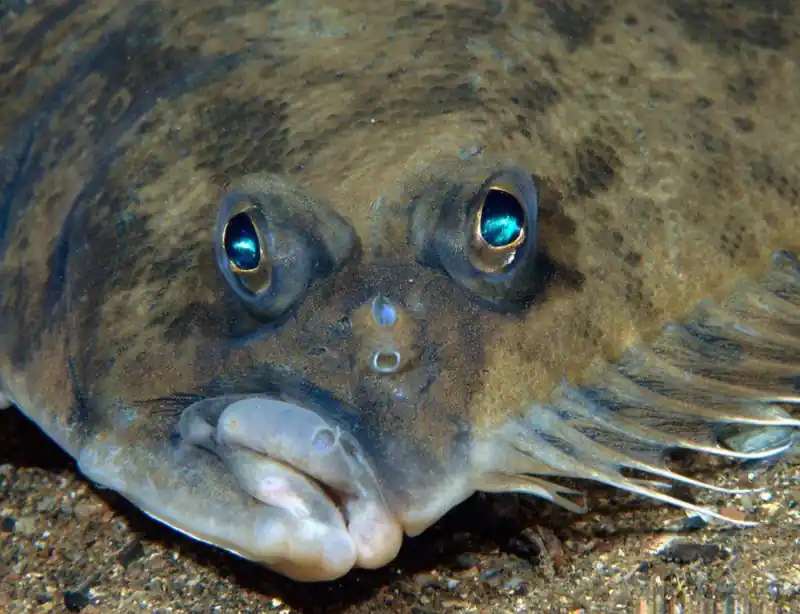
Ah, the ocean—a giant cauldron of weird and wonderful fish. You’ve got flying fish darting around like hopeless romantics trying to elope, electric eels zapping like walking power banks, and mimic octopuses pretending to be dead, straight-up Oscar-worthy masters of disguise. But when it comes to the “Most Ridiculous-Looking Fish” leaderboard, there’s only one champion: the flounder! This guy looks like Mother Nature played a prank and forgot to close her mouth: both eyes squished to one side of the face, body flattened like a pancake that’s been smashed by waves 800 times, and it just casually lies on its side all day. Call it a fish? Sure, if you insist—but it swims like a happy little side-liner. Call it not a fish? Well, it still swims. The flounder is, in the vast fishy cosmos, the only rebel openly defying the sacred law of symmetry. No wonder old Darwin scratched his head—did God have one too many drinks, or is evolution just a dark comedy? Either way, the flounder’s “crooked-face aesthetic” proves one thing: sometimes asymmetry is the tastiest flavor of all!
1. This isn’t a deformity—it’s “custom asymmetry” at its finest
When most people first encounter a flounder, their immediate reaction is: “Did this fish fall face-first out of its mom’s womb or something?” Hold your horses—that’s not a random genetic glitch, nor is it an ecological disaster caused by pollution. This is evolution’s ultimate flex, honed over millions of years.
Picture the flounder’s ancient ancestors: proper little fish, perfectly symmetrical, one eye on each side, scanning the sea world in 360 degrees. Life was tough back then. Shellfish ruled the reefs, predators lurked everywhere, and the competition was fierce. So what did the flounder do? It tried a clever trick: lie on its side. Yup—just flop over, snuggle against the sand, and become practically invisible. At first, it was a casual experiment. But soon, it worked like a charm. Side-lying became the new normal, and generations of these flat, sand-loving fish happily joined the “Side-Lying Party.”
But there was a catch: the “bottom eye” got a raw deal. Pressed against the sand day after day, it saw nothing—like an office worker glued to a monitor until their eyeballs start to warp. That eye wasn’t happy. Slowly, it started creeping upward, until one day… voilà! Both eyes had “moved in” to the same side of the face. One side now had a full 360-degree surveillance setup, while the other remained a barren wasteland. The body flattened further, bones twisted, and the fish became a living, breathing “camouflage rock.”
The advantage? Less neck strain when peeking upward. Predators passed by, fooled into thinking it was just another piece of sand or reef. Fossils confirm the saga of this “twisted evolution.” This wasn’t a fluke—it was survival pressure shaping a perfect side-lounger. Flounders are the ocean’s only naturally asymmetrical vertebrates. Not a glitch, but evolution’s “premium edition.” Not a loss, but a sea-floor Zen assassin mode.
Unlike stingrays that elegantly glide above the seabed, flounders wobble along like drunken sailors. But the design is practical: in the vast, endless blue, this asymmetrical fish has effortlessly outsmarted all its symmetrical cousins.
2. Lefties vs. Righties: Flounders even have factions
And if you think that’s weird enough, hold on: the flounder family has factions—“left-siders” and “right-siders.” Half lie on their left (eyes migrated to the right, like the European flounder), half lie on their right (eyes on the left, like the common flounder). Evolutionary tug-of-war? Basically. It’s like human lefties and righties—except these fish clearly pick which way their face turns, starring in an underwater “party of sides.”
Scientists are baffled. Some guess it’s a genetic lottery: one parent left, one parent right, and the babies draw straws. Others say it’s a natural backup plan—if left-siders get eaten by a crab, right-siders fill in. Some even joke: “Maybe an ancestor just got up on the wrong side of the sand one day, and the trait stuck.”
Regardless, this “choose your side” system actually helps flounders find the best camouflage in any seabed. You never know if the next sand mound will pop up a left-eye or right-eye fish. Lefties grumble: “Right-siders are too mainstream.” Righties complain: “Lefties are way too picky.” Next time you visit an aquarium, count them—they coexist peacefully, yet each side flaunts its flair. Diversity rules the ocean.
3. Darwin would’ve given a thumbs-up: This isn’t a bug—it’s a feature
When Darwin first glimpsed a flounder specimen, he must have been floored: “What the heck is this thing?!” He likely sighed: “Surely a genetic accident, evolution’s whim gone rogue.”
Science, however, isn’t satisfied with whims. Fossil evidence shows that flounder ancestors were quite symmetrical—newbie villagers of the fish world. But over time, evolution rewrote the script. The flounder proved that true power isn’t standing tall—it’s lying low. They don’t need flashy scales or lightning speed. One motionless flop, and they evade predators, ambush prey, and reign as the ocean’s “invisible kings.”
Darwin would have loved it: “This isn’t a bug, it’s a feature!” In the cutthroat game of survival, flounders quietly thrive, elegantly winning while the rest of us straight-faced humans overthink symmetry. Sometimes, crooked is clever.
Conclusion: Crooked but classy
In short, flounders show us that evolution isn’t a sprint—it’s a long, absurd marathon. Mutations? Just an excuse. Environmental pressure? A push. The truth: the ocean has a dark sense of humor—sometimes the most asymmetrical fish embodies the perfect art of survival.
So, next time you spot a flounder at the fish market with a face so lopsided it wouldn’t recognize its own mother, don’t laugh. It’s not a deformity—it’s evolutionary art. Not a loser—it’s a Zen assassin of the sea. One eye watching the world, and yet it has mastered survival for millions of years.
Oh, and if this fishy gossip made you chuckle, give a like and follow! Next time, we’ll dive into “Why octopuses have three hearts yet live like eternal bachelors.” Underwater oddities never stop.
And flounders, thanks for your crooked-face enlightenment—maybe humans should learn a thing or two. Sometimes, tilting your head a bit is what makes life fun.