
Ever stared at your shadow stretching across the pavement and wondered: Does a shadow have mass? It’s one of those quirky questions that sounds like playground chatter but dives deep into physics. We’re talking does a shadow have physical weight? and what is the essence of a shadow? Spoiler: Your silhouette is massless magic, but understanding why reveals the universe’s clever tricks. If you’re curious about shadow physics or just want to geek out on light without a textbook, this guide’s for you.
- What Is the Essence of a Shadow? The Simple Science Behind the Darkness
- Does a Shadow Have Physical Weight? Light’s Massless Mayhem
- Why Can’t We Weigh a Shadow’s Mass? The Lab’s Limits Exposed
- Shadow Physics in Everyday Life: From Patios to Probes
- Wrapping Up: Shadows—Lightweight Lessons in a Heavy Universe
In this post, we’ll unpack the science behind shadows, from their geometric roots to Einstein’s energy twists. Plus, we’ll tackle why we can’t weigh a shadow’s mass—even with the fanciest scales. Let’s chase some light (and shade) together.
What Is the Essence of a Shadow? The Simple Science Behind the Darkness
At its core, what is the essence of a shadow? It’s not a “thing” you can poke—it’s a shadow’s absence of light. Imagine photons racing from the sun like straight-shooting arrows. Hit a blocker (your body, a coffee mug), and the beam stops. The unlit patch behind? That’s your shadow—a geometric void where light never arrives.
This isn’t fluffy philosophy; it’s light physics 101. Shadows form because light travels in straight lines (no detours for drama). Key factors:
- Light source size: Pinpoint beam (like a flashlight)? Crisp edges. Broad glow (overcast sky)? Blurry fade.
- Distance and angle: Morning sun elongates shadows; midday sun squishes them flat.
- Obstacles: Opaque objects cast full umbras; translucent ones blur into penumbras.
Real-world ripples? Shadows cool things down—does a shadow have physical weight? Nope, but its chill factor (missing solar energy) drops temps by 10-20°F in direct sun. Plants adapt too: Shade-grown veggies sprawl wider for max light catch. Essence distilled: Shadows are light’s negative space, sculpting our world without adding a gram.
Does a Shadow Have Physical Weight? Light’s Massless Mayhem
Straight to the heart: Does a shadow have mass? Short answer: Zero. Photons—the particles of light—carry no rest mass. They’re cosmic sprinters at 186,000 miles per second, hauling energy and momentum but no baggage.
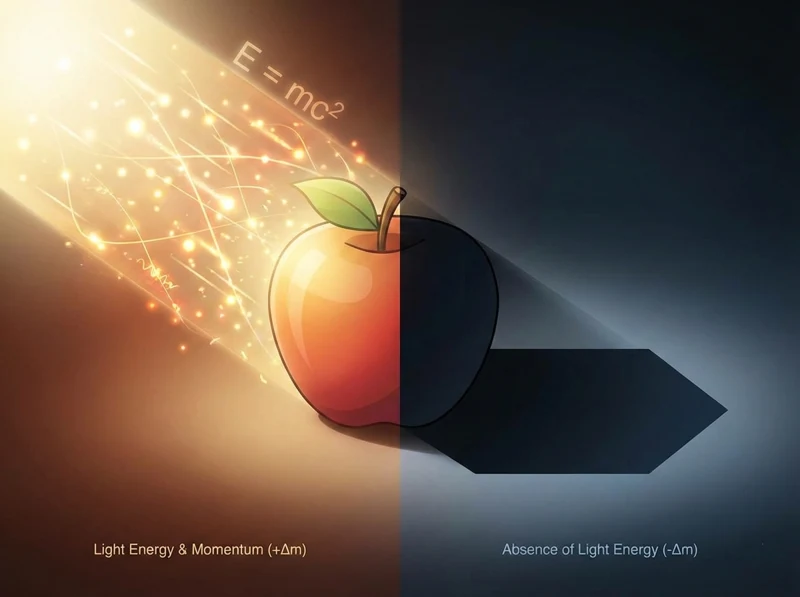
Yet light feels weighty. Sunburn sting? Photons dumping heat. Solar sails propelling probes? Photon “push” via momentum transfer. So, if light packs punch without mass, does a shadow have physical weight from its void? Enter E=mc²: Einstein’s gem showing energy equals mass (times light speed squared). Light’s energy adds a whisper of “equivalent mass” to lit spaces—like a sealed box gaining a femtogram from trapped beams.
Shadows flip it: No photons = no energy boost = no mass add-on. Not negative weight (energy doesn’t debt like that), just neutral. Under noon sun, that “missing mass”? About 10^{-15} grams per square meter—lighter than a virus’s eyelash. Fun fact: The sun converts 4 million tons of mass daily into light energy. Your shadow? Just opting out of the party.
Why Can’t We Weigh a Shadow’s Mass? The Lab’s Limits Exposed
If shadows tweak mass theory, why can’t we weigh a shadow’s mass? Blame precision’s edge. Classic scales laugh it off: Put twin objects—one lit, one shaded—on a balance. Readings match. Shadows aren’t “stuff”; they’re gaps.
Dig deeper: Labs chase phantoms with microgram-sensitive gear. Controls zap confounders:
- Heat haze: Lit spots warm air, tweaking buoyancy (hot air rises, lightens load).
- Radiation nudge: Sunlight’s 4.5 µN/m² pressure? A photon pat—gone in shade, but not mass magic.
- Quantum quirks: Double-slit tests birth “interference shadows” from wave cancel-outs. Vacuum fizz (virtual particles popping everywhere) evens the energy field—no shadow favoritism.
Results? Nada. Even cryogenic setups (near absolute zero) find zilch attributable to shadows. The “mass gap” drowns in noise: Instrument floors hit 10^{-9} grams; theory’s at 10^{-15}. Why can’t we weigh a shadow’s mass? It’s there in equations, buried in reality—like whispering in a hurricane.
| Factor | Lit Area Effect | Shadow Effect | Weighable? |
|---|---|---|---|
| Energy Input | Photons add heat/momentum | Total absence | No—too faint |
| Temperature Shift | +10-20°F | Cooler baseline | Indirect (buoyancy only) |
| Quantum Fluctuations | Even baseline | Even baseline | Neutral |
| Radiation Pressure | Micro-push | Zero | Detectable in space, not labs |
Shadow Physics in Everyday Life: From Patios to Probes
Shadows’ massless essence powers cool tech. GPS? Accounts for E=mc² in satellite clocks. Solar farms? Harvest light’s “weightless” energy. Backyard hack: Shade sails cool patios by blocking photon heat, not by “weighing down” air.
Globally, shadows shape ecosystems—coral reefs thrive in dappled light; deserts bake under relentless rays. Next Yuanlin stroll (those Taiwanese sunsets slay), spot your shadow: It’s proof of light’s dance, mass-free but mighty.
Wrapping Up: Shadows—Lightweight Lessons in a Heavy Universe
So, does a shadow have mass? Nope. Does a shadow have physical weight? Still no—it’s essence is pure omission. And why can’t we weigh a shadow’s mass? Science’s tools aren’t sharp enough yet. But that’s the thrill: Shadows spotlight what’s not there, echoing Einstein’s “God does not play dice” with light’s straight-arrow rules.
Got a shadow story or physics puzzle? Comment below—let’s geek. Share if this lit your curiosity. Stay shady, friends.
Further Reading: Is a Sheep a Type of Cow? Biological Proof That Sheep Belong to the Bovidae Family