
The startling truth is that, in rigorous animal taxonomy, sheep belong to the Bovidae family (Bovidae). While in our everyday perception, cows and sheep appear to be completely different animals, this scientific classification is based on shared, fundamental traits. This article will reveal why this animal classification is accurate and provide the biological proof.
- Four Shared Traits of Bovidae: The Evidence That Sheep Belong to the Cow Family
- 1. The Defining Bovidae Trait: Hollow, Non-branching Horn Structure
- 2. Efficient Ruminant Digestive System: Rumen, Reticulum, Omasum, Abomasum
- 3. Shared Evolutionary Relationship
- 4. The Scent Mystery: Unifying Mutton Odor and Milk Flavor
- Practical Tips: How to Quickly Distinguish Cows, Sheep, and Other Bovidae?
- Lifestyle Focus: How to Manage or Utilize the Mutton Odor?
- The Diversity of Bovidae: Why Are Wildebeest and Musk Ox Also Bovidae?
- Continue Exploring Nature’s Wonders
This might sound incredible, but from a biological standpoint, this classification of cows and sheep is based on their high degree of consistency in evolutionary relationships, morphology, and biological characteristics.
Four Shared Traits of Bovidae: The Evidence That Sheep Belong to the Cow Family
The inclusion of sheep in the Bovidae family is not arbitrary, but based on a series of key Bovidae characteristics:
1. The Defining Bovidae Trait: Hollow, Non-branching Horn Structure
One of the most crucial identification markers for Bovidae animals is their horns. Sheep horns exhibit typical Bovidae traits:
- Hollow Core: The interior of the horn is hollow, with a bony core covered by a keratin sheath.
- Permanent: The horns are generally not shed and last for the animal’s lifetime.
- Non-Branching: The structure of the horn is simple and does not fork.
This unique horn structure is the key to distinguishing Bovidae animals from other horned creatures (such as deer, which have solid, shed, and branched antlers), and it serves as vital proof that sheep belong to the Bovidae family.
2. Efficient Ruminant Digestive System: Rumen, Reticulum, Omasum, Abomasum
In terms of the digestive system, sheep, like other members of the Bovidae family, possess a highly efficient and complex ruminant digestive system. They are equipped with four stomach chambers: the rumen, reticulum, omasum, and abomasum.
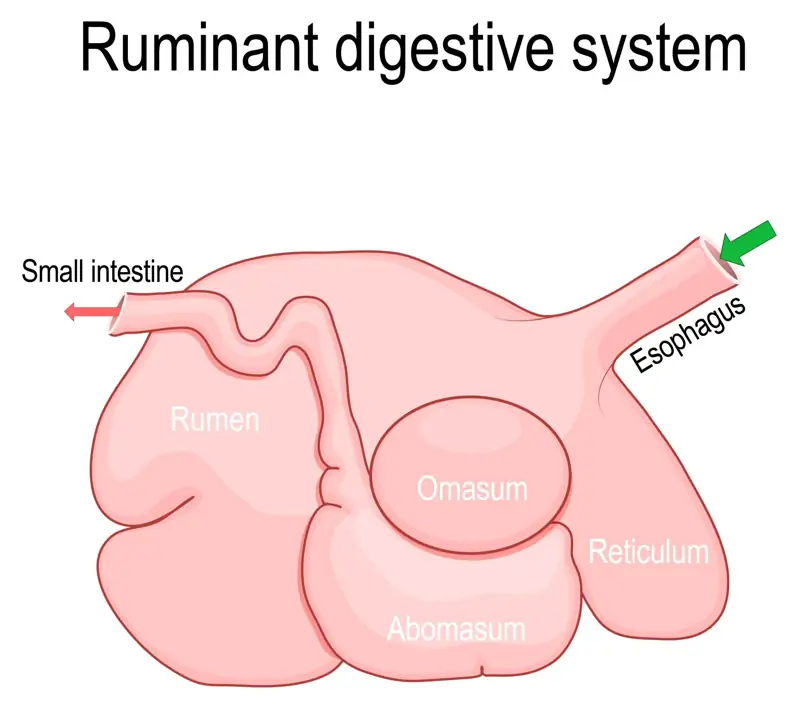
This specialized structure allows them to efficiently digest plant matter rich in cellulose. This system is a critical adaptation that Bovidae animals evolved to thrive on a grass-eating diet over long periods.
3. Shared Evolutionary Relationship
From the perspective of biological evolutionary relationships, cows and sheep shared a common ancestor over ten million years ago. Their similarities remain clearly visible today, serving as a fundamental biological basis for why sheep are classified as Bovidae.
4. The Scent Mystery: Unifying Mutton Odor and Milk Flavor
Some may ask: “If sheep belong to the Bovidae family, why does mutton have a distinct pungent odor (mutton odor), while beef does not?”
This odor is not due to the meat itself but is the result of unique microbial activity within the sheep, as a ruminant animal. Large numbers of microbes in the rumen produce high amounts of short-chain fatty acids during food digestion.
- These fatty acids are highly volatile and circulate via the bloodstream, distributing into the animal’s fat tissues.
- When the mutton is cooked, these volatile short-chain fatty acids are released, creating the familiar “mutton odor.”
Interestingly, if the concentration of these fatty acids is appropriately lowered, the released aroma can instead carry a milky flavor, similar to that of milk. Therefore, the mutton odor is essentially a byproduct of the unique digestive process shared by Bovidae animals.
Practical Tips: How to Quickly Distinguish Cows, Sheep, and Other Bovidae?
Although they are all part of the Bovidae family, we can still differentiate common members in daily life using simple visual and behavioral characteristics:
| Distinguishing Feature | Cattle (Domestic Cow) | Sheep (Goat/Domestic Sheep) | Wildebeest/Antelope (Bovidae) |
| Body Size | Large, muscular | Relatively small, compact | Medium to large, long and agile legs |
| Horn Shape | Mostly curved outward, round or flattened | Often spiral, curved backward, or curled tight to the head | Highly diverse (e.g., spiral, crescent-shaped), often used for balance during rapid movement |
| Beard/Whiskers | No obvious facial hair | Goats often have distinct chin whiskers | Wildebeest have prominent facial and neck manes |
| Behavior | Generally slow-moving, smaller groups | Good climbers (goats), or form huge flocks (domestic sheep) | Known for high-speed running and long-distance migrations |
| Tail | Quite long with a tuft of hair at the end, used for swatting flies | Short and typically droops | Medium-long, like a horse’s tail (wildebeest), or shorter (antelope) |
Lifestyle Focus: How to Manage or Utilize the Mutton Odor?
For cooking enthusiasts, understanding the source of the odor allows for targeted treatment.
| Treatment Goal | Practical Method | Underlying Principle |
| To Remove Odor | Spice Masking: Use strong spices like cumin, cloves, or angelica root. | Volatile oils in spices bind with or mask the scent of the short-chain fatty acids. |
| Acid/Base Neutralization: Add vinegar, liquor, or lemon juice during cooking. | Alcohol or acidic substances can dissolve or react with some volatile fatty acids. | |
| Cold Soaking/Blanching: Soak the mutton in cold water to draw out blood, or quickly blanch it in boiling water. | Physical removal of some fatty acids and impurities adhering to the meat surface. | |
| To Utilize the Flavor | Pair with Dairy: Add a small amount of milk or yogurt to stews. | Dairy fat and protein can absorb some of the strong odor while enhancing the inherent milky flavor notes of the lamb. |
The Diversity of Bovidae: Why Are Wildebeest and Musk Ox Also Bovidae?
The variety within the Bovidae family extends far beyond our initial ideas. Besides cows and sheep, it includes members with highly misleading names and appearances, further enriching the gene pool of Bovidae animals:
🦌 Wildebeest
The wildebeest is an “identity confuser” within the Bovidae family.
- From a distance, its agile posture resembles a horse.
- Closer up, it possesses horns similar to a cow.
- Upon closer inspection, its facial beard and coarse hair show traits similar to a sheep.
Despite its composite appearance, the wildebeest is an undisputed member of the Bovidae family in animal taxonomy.
🐂 Musk Ox
Based on its name, it is often mistaken for a type of cow. However, its taxonomic status places it closer to the sheep: it belongs to Bovidae → Caprinae (Goat-Antelopes Subfamily) → Ovibovini (Musk Ox Tribe).
The musk ox is actually considered a specialized type of sheep, being the largest and woolliest member of the Caprinae subfamily.
Sheep are classified as Bovidae because they exhibit a high degree of convergence in evolutionary relationships, horn morphology, and the ruminant system—all defining Bovidae characteristics. While cows and sheep differ significantly in appearance and behavior, from a broad biological perspective, they belong to one closely linked family. Understanding this classification not only satisfies our curiosity but also helps us approach these animals and their products more scientifically in our daily lives.
Continue Exploring Nature’s Wonders
If you’re fascinated by surprising animal facts, you’ll love this next article! Discover creatures with abilities far beyond those of the Bovidae family. Click here to see Crows, Rabbits, Polar Bears, and Snails: Nature’s Most Mind-Blowing “Superpowered” Animals!