
If you ask someone how old the universe is, there’s a good chance they’ll answer immediately:
“About 13.8 billion years old.”
It’s one of those facts that gets repeated so often it starts sounding ordinary, even though it’s probably one of the strangest things humanity has ever claimed to know. After all, nobody watched the universe begin. Nobody stood there with a stopwatch waiting for the Big Bang.
So how did scientists come up with such a precise number?
The answer leads to something called the Hubble constant, and honestly, the deeper you go into it, the weirder the story becomes.
Because the Hubble constant doesn’t just measure the universe. It exposes the possibility that our understanding of reality might still be incomplete.
The Universe Never Stopped Moving
The easiest way to think about the Hubble constant is to imagine arriving at a lake a few seconds after someone threw a rock into the water.
You miss the splash itself, but the ripples are still spreading outward. If you know how fast the ripples are moving, you can roughly figure out when the rock must have hit the surface.
That’s basically what astronomers are doing with the universe.
When scientists look into deep space, they notice something odd: almost every distant galaxy appears to be moving away from us. Even stranger, the farther away the galaxy is, the faster it seems to be receding.
This discovery completely changed modern astronomy.
For a long time, people assumed the universe was static and eternal. Then astronomers like Edwin Hubble showed that space itself is expanding.
The Hubble constant is simply the number used to describe how fast that expansion is happening.
Why the Hubble Constant Matters
At first, the Hubble constant sounds like just another piece of scientific jargon.
But it’s actually one of the most important numbers in cosmology.
If the universe is expanding today, then logically, everything must have been closer together in the past. Reverse the expansion far enough, and eventually you arrive at an incredibly dense beginning — the event we now call the Big Bang.
That means the Hubble constant can help estimate the age of the universe itself.
A larger Hubble constant suggests the universe expanded quickly and reached its current size faster, meaning the universe would be younger.
A smaller value implies a slower expansion and an older universe.
So in a strange way, scientists estimate the universe’s age by measuring motion instead of time.
Measuring the Universe Was Harder Than Anyone Expected
The difficult part wasn’t measuring speed.
Modern telescopes can analyze light from galaxies and calculate how much it has shifted toward the red end of the spectrum, a phenomenon called redshift. That tells astronomers how quickly galaxies are moving away.
Distance, however, was a completely different problem.
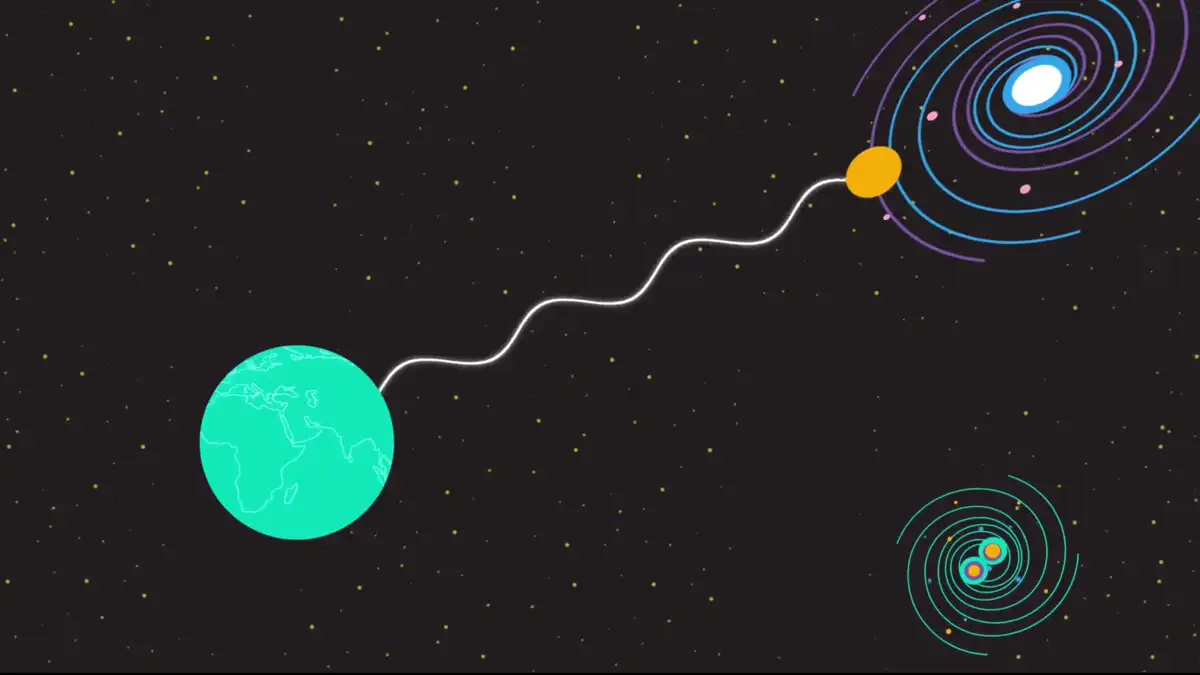
A galaxy can look faint because it’s incredibly far away, or simply because it doesn’t produce much light. Early astronomers had trouble separating those possibilities.
Then scientists discovered a special type of star called a Cepheid variable.
These stars pulse in brightness almost like breathing. More importantly, their pulsation rhythm is directly connected to their true brightness. By observing the timing of those pulses, astronomers can estimate how bright the star actually is.
Compare that true brightness with how bright it appears from Earth, and suddenly you have a way to calculate distance across space.
That breakthrough allowed Hubble to discover something shocking: the universe was expanding everywhere.
The Moment the Universe Became Younger Than Earth
There was just one issue.
Hubble’s original measurements gave a value for the Hubble constant close to 500.
That number implied the universe was only around 2 billion years old.
Which immediately created a problem, because even back then scientists already believed Earth itself was older than 4 billion years.
A universe younger than its own planet obviously made no sense.
The mistake turned out to be caused by limited telescope precision. Different kinds of Cepheid stars had been confused with one another, throwing off the entire distance calculation.
What’s interesting is that this mistake stayed unresolved for decades. Modern science often feels clean and inevitable when you read about it afterward, but in reality, progress is usually messy. People work with incomplete data, argue constantly, and sometimes spend years trusting numbers that later turn out to be wrong.
The story of the Hubble constant is full of moments like that.
The Cosmic Distance Ladder
To improve the measurements, astronomers slowly built what became known as the cosmic distance ladder.
The process works almost like crossing a river using stepping stones.
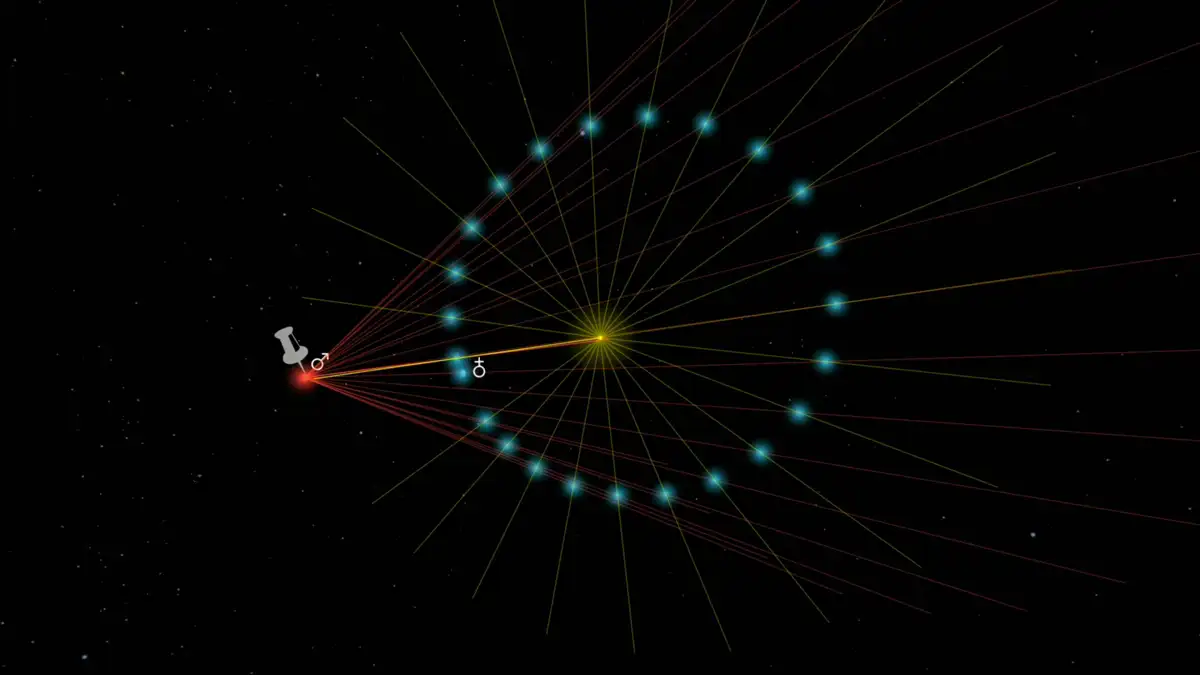
First, scientists measure nearby stars using stellar parallax, which tracks tiny positional shifts caused by Earth orbiting the Sun. That method is highly accurate, but only for relatively close stars.
After that come Cepheid variables, which help map nearby galaxies.
Then astronomers use Type Ia supernovae — exploding stars that reach nearly identical brightness levels every time they detonate. These supernovae act almost like standardized cosmic light bulbs, allowing researchers to measure enormous distances across the universe.
By the 1990s, the Hubble Space Telescope dramatically improved the precision of these observations.
Teams led by scientists like Adam Riess eventually measured the Hubble constant at around 73 kilometers per second per megaparsec.
That result pointed toward a universe approximately 13.8 billion years old.
For a while, it looked like cosmology had finally settled the question.
Then the Hubble Tension Appeared
But the universe had one more surprise waiting.
Another group of scientists approached the problem differently. Instead of measuring nearby galaxies, they studied the oldest light in existence: the cosmic microwave background.
This faint radiation is basically the leftover glow from the early universe, created roughly 380,000 years after the Big Bang.
Using data from the Planck spacecraft, researchers calculated a different value for the Hubble constant.
Not 73.
Closer to 67.
The difference may sound small, but in precision cosmology it’s massive. This disagreement became known as the Hubble tension, and it has quietly become one of the biggest mysteries in modern astronomy.
Because both measurements seem reliable.
And that’s the unsettling part.
Maybe the Universe Is Missing Something
For years, scientists hoped the Hubble tension would disappear after better measurements arrived.
Instead, the opposite happened.
In 2024, the James Webb Space Telescope rechecked many of the observations behind the higher Hubble constant value and largely confirmed them.
Which means the disagreement is now harder to dismiss as a simple error.
So physicists have started asking bigger questions.
Maybe dark energy changes over time.
Maybe there was an unknown form of radiation in the early universe.
Maybe the standard model of cosmology is missing some hidden piece of physics we still don’t understand.
Or maybe there are still tiny observational errors hiding somewhere deep inside the calculations.
Right now, nobody really knows.
The Strange Thing About Science
I think that’s what makes the Hubble constant so fascinating.
It’s not just a number. It’s a reminder that science is still unfinished.
People sometimes imagine astronomy as a field filled with certainty, where every mystery has already been mapped out by equations and giant telescopes. But the deeper you look into the universe, the more you realize how much uncertainty still exists beneath the surface.
The famous “13.8 billion years” is not a final answer carved into stone.
It’s simply the best explanation humanity currently has.
And somewhere between 67 and 73, the universe may still be hiding a secret we haven’t learned how to see yet.
The strange thing about the Hubble constant is that it’s not the only place where the universe feels slightly “off,” as if reality still has pieces missing. That same feeling appears at the edge of our own solar system, where Voyager 2 detected bizarre changes in radiation and magnetic fields after crossing into interstellar space. If you enjoy these kinds of cosmic mysteries, you might also like Are Humans Trapped in the Solar System? The Truth Behind Voyager 2 Crashing into “Invisible Walls”