

A strange question has a way of appearing late at night.
Not the practical kind of question. Not the sort that helps you pay bills or fix something around the house. The other kind—the ones that start small and somehow end up changing the way you look at the world.
This one arrived while I was reading about extinction.
If humanity vanished tomorrow, completely and without warning, what would happen next?
The first part is easy to imagine. Nature would return with surprising speed. Within a few decades, vines would begin climbing empty buildings. Roads would crack. Subways would flood. A century later, many cities would already look less like human settlements and more like archaeological sites swallowed by vegetation. Given enough time, forests would reclaim entire regions, coastlines would shift, and the traces of our civilization would slowly blur into the landscape.
But that isn’t the question that kept bothering me.
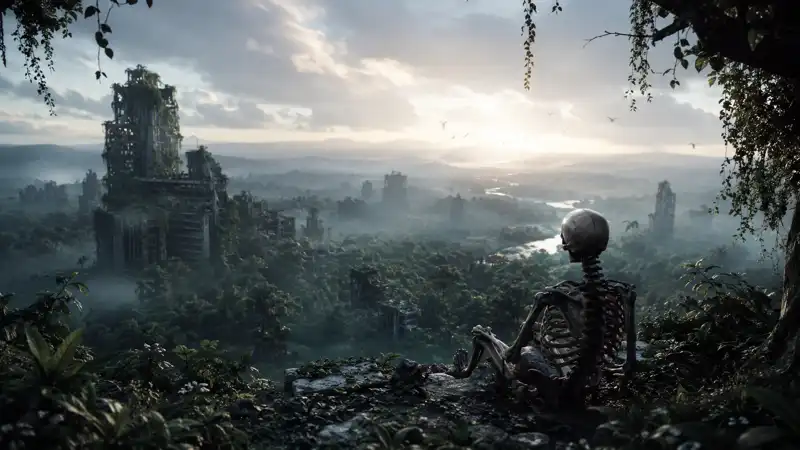
The more interesting question comes later, perhaps millions of years later, after our ruins have eroded into nothing and no evidence of humanity remains above the surface. At that point, would evolution simply try again? Would another species rise from the ashes of Earth’s long history, discover science, build telescopes, and stare into the night sky wondering where it came from?
For most of my life, I assumed the answer was yes.
After all, intelligence seems so powerful that it feels almost inevitable. We tend to view evolution as a kind of upward journey, beginning with simple organisms and gradually climbing toward greater complexity. Single-celled life becomes multicellular life. Fish crawl onto land. Mammals appear. Primates evolve larger brains. Eventually, someone invents mathematics and starts arguing about the age of the universe on the internet.
From that perspective, humanity looks less like an accident and more like the next logical step.
The problem is that evolution doesn’t seem to agree.
The more biologists study the history of life, the less evidence they find that intelligence is evolution’s preferred destination. Nature rewards survival, not wisdom. A species that successfully reproduces for a hundred million years has achieved evolutionary success whether it invents philosophy or not. Intelligence is only one strategy among many, and in some ways it is a surprisingly inefficient one.
Dinosaurs are a useful reminder of this.
They ruled Earth for roughly 165 million years. That number is difficult to grasp because human civilization feels ancient to us, yet agriculture appeared only about ten thousand years ago. Written history covers a tiny fraction of that. Dinosaurs, by comparison, dominated the planet for a span of time so vast that human history almost disappears beside it.
And yet they never built anything resembling a civilization.
No cities. No metallurgy. No astronomy.
Not because they failed, but because they didn’t need to.
This is one of the strangest lessons hidden inside evolution. The traits that seem impressive to us are not necessarily the traits nature values most. A crocodile is often described as a living fossil because its basic design has remained remarkably effective for tens of millions of years. Sharks have existed in some form longer than trees. Countless organisms have survived by becoming specialized, efficient, and stable rather than increasingly intelligent.
Human beings are unusual partly because we chose a far more expensive path.
Our brains consume an astonishing amount of energy. Although they make up only a small percentage of our body mass, they require a disproportionately large share of our daily calories. From an evolutionary perspective, this is a risky arrangement. A large brain is not a free upgrade. It demands resources, developmental changes, and environmental conditions that many species never encounter.
Sometimes I think we forget how many unlikely events had to line up before human intelligence became possible.
Our ancestors learned to walk upright, freeing their hands. They developed increasingly sophisticated tools. At some point, they learned to control fire, which allowed them to cook food and extract more energy from what they ate. Social groups became larger and more complex. Language emerged. Knowledge began accumulating instead of disappearing with each generation.
Looking backward, the path seems almost obvious.
Looking forward from the past, however, it probably looked impossible.
This is why some scientists argue that if we could rewind Earth’s history like an old videotape and press play again, the outcome would be dramatically different. The continents would still move. Natural selection would still operate. Life would still evolve.
In fact, this idea isn’t limited to evolution alone. It connects to a much larger question about how fragile our place in the universe really is, something I explored in more detail when looking at how time itself shapes the boundaries of existence in how old the universe really is. Once you start connecting these ideas, it becomes harder to see civilization as something stable rather than something temporarily balanced between chance and physics.
But humans?
Humans might never appear.
A different asteroid might strike at a different moment. A different climate shift might reshape ecosystems. A different branch of mammals might thrive while our ancestors vanish entirely. Tiny accidents, repeated over hundreds of millions of years, can alter the course of evolution in ways that become impossible to predict.
What begins to emerge from this perspective is a deeply uncomfortable possibility.
Maybe intelligence like ours was never guaranteed.
Maybe it happened once because a long chain of improbable events happened to cooperate.
And if that’s true, then another civilization is not waiting somewhere in Earth’s future.
It may never arrive at all.