
Do you believe it? Perhaps our solar system is wrapped in three mysterious invisible walls—they shield life on Earth like a fortress, and yet feel like a prison locking human civilization in. The clues all come from a single probe that’s been flying for 46 years: Voyager 2.
Voyager 2: The “Messenger” Still Traveling Through Interstellar Space
Launched in 1977 by NASA, Voyager 2 is a modest 823-kg spacecraft tasked with exploring the outer solar system. It flew by Jupiter, Saturn, Uranus, and Neptune, sending back troves of images and data—arguably one of humanity’s greatest space exploration successes.
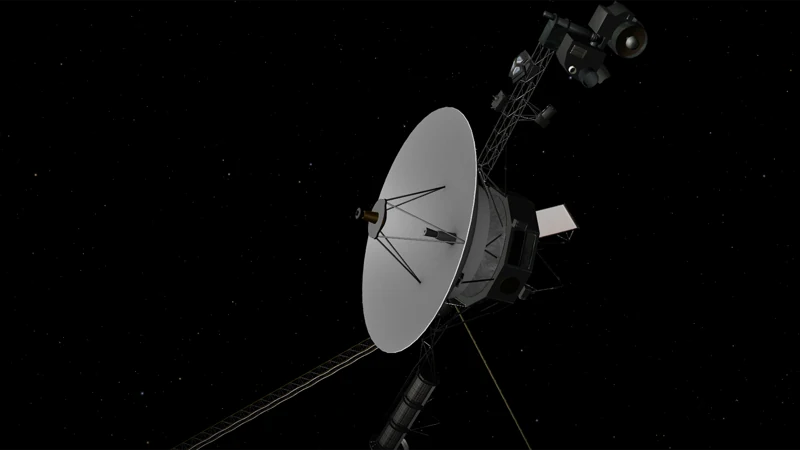
Now, 46 years later (as of 2025), Voyager 2 continues moving outward into deep space. It’s about 166 astronomical units (AU) from Earth—that is, 166 times the average distance between Earth and the Sun. At that distance, the Sun is no longer a blazing star but a faint dot in the sky, with a brightness only about one-thousandth that of a full moon.
Just when most expected Voyager 2 to slip quietly into interstellar space, something astonishing happened.
First Wall: The Heliosphere Boundary (Heliopause) — The Solar System’s “Energy Frontier”
In November 2018, sensors aboard Voyager 2 suddenly triggered alerts: temperatures skyrocketed to 500 million Kelvin, the magnetic field direction inverted dramatically, and particle flux data behaved in bizarre ways. Scientists were stunned.
NASA later confirmed: Voyager 2 had “hit” the solar system’s first invisible wall—the heliopause.
This isn’t a solid wall, but a dynamic boundary zone. Here, the stream of charged particles from the Sun (the solar wind) collides with the interstellar medium (mainly hydrogen and helium) in our galaxy. That boundary is the edge of the heliosphere, and crossing it means entering genuine interstellar space. Inside lies a region where the Sun’s magnetic and particle influence fades rapidly, and cosmic radiation intensifies. You could say the heliosphere is the Sun’s protective dome over the solar system.
Second Wall: The Bow Shock — The “Jelly Trap” of Interstellar Space
But the heliopause isn’t the end. Beyond it lies a trickier obstacle commonly called the bow shock (or colloquially the “blue wall”).
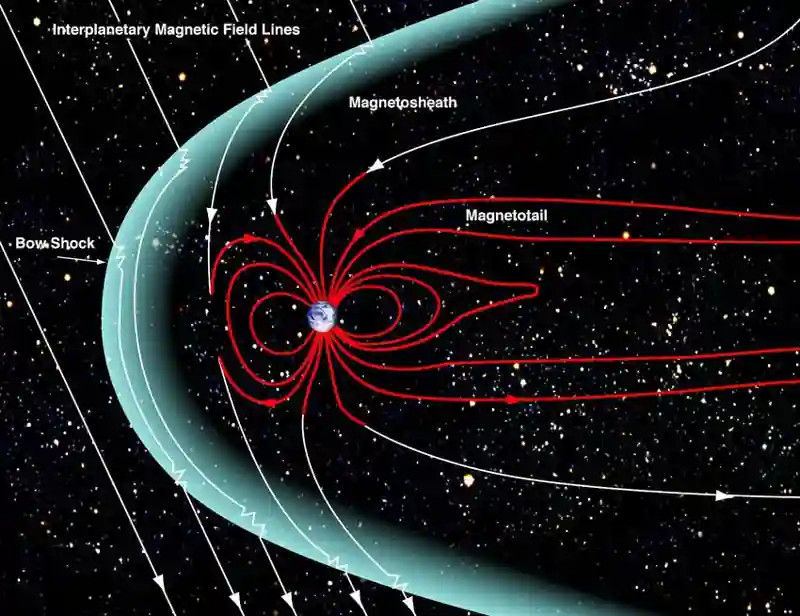
As the Sun drifts through the galaxy at about 220 km/s, it pushes against the interstellar medium ahead of it, compressing plasma in front—much as an aircraft flying supersonically creates a shockwave. In this region, fast-moving charged particles suddenly encounter strong resistance and slow down, as though entering a blob of cosmic “jelly.” This harsh environment could disrupt instruments, navigation, and structural stability of future interstellar crafts.
Voyager 2 experienced signal dropouts, odd data, and brief “outages” as it neared this zone. Scientists hypothesize these were caused by severe electromagnetic turbulence interfering with its instruments. It’s a stark reminder: passing the heliopause is only one hurdle; interstellar travel still holds many perils.
Third Wall: The Oort Cloud — The Solar System’s “Ultimate Frontier”
If the first two walls are energy and plasma boundaries, the third wall is a real astronomical structure: the Oort Cloud.
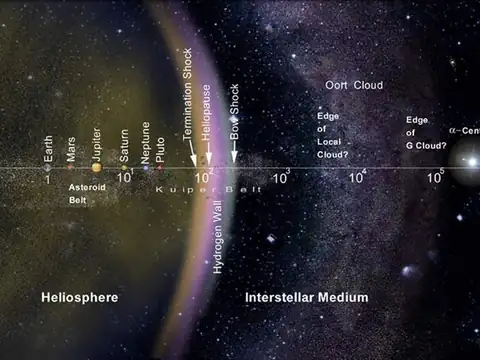
Proposed in 1950 by Dutch astronomer Jan Oort to explain the origin of long-period comets, the Oort Cloud is thought to be a huge spherical shell surrounding the solar system at distances from ~10,000 to ~200,000 AU (roughly 1.5 to 3 light-years). It’s filled with trillions of frozen bodies of ice, dust, and rock—remnants from the solar system’s formation.
Here’s the mystery: at such immense distances, the Sun’s gravitational grip is extremely weak. Why haven’t these objects drifted away over billions of years?
One possible explanation is dark matter.
The “Invisible Scaffold” Hypothesis of Dark Matter
We know that visible matter makes up only about 5% of the universe; the rest is dark matter (≈27%) and dark energy (≈68%). Dark matter doesn’t emit or absorb light, and escapes direct detection, but its gravity shapes galaxies and cosmic structure.
Some theories propose that around the Oort Cloud resides a dark matter halo whose gravitational field provides extra binding, acting like an invisible scaffold that helps keep those distant icy bodies from escaping.
Even more provocatively, some scientists suggest that the asteroid or comet causing the extinction of the dinosaurs about 66 million years ago might have originated in the Oort Cloud. Perturbations by passing stars or fluctuations in dark matter might nudge an object into the inner solar system, turning it into a deadly “comet killer.”
Is the Solar System a “Cosmic Prison”?
By now you may ask: is the solar system truly a carefully designed cosmic prison? Are humans destined to forever remain trapped?
From a practical standpoint, yes—it’s extremely difficult with our current technology. Voyager 2 travels at ~15 km/s, and after 46 years it only just crossed the heliopause. It would take roughly 300 more years to reach the inner Oort Cloud, and 30,000 years to cross it entirely. Along that journey, probes must survive cosmic radiation, micrometeoroid impacts, power loss, and potential collisions with Oort objects. Currently, manned interstellar flight is nearly impossible.
But the “walls” are not purely constraints—they also provide benefits.
- The heliosphere shields us from much of the dangerous interstellar radiation.
- The Oort Cloud, though remote, is the wellspring of comets, which may have delivered water and organic molecules to early Earth—helping life begin.
- The “blue wall” of turbulence offers a natural laboratory to study how the Sun interacts with the galaxy.
The Future: Break Through or Coexist?
Human innovation has never stood still. Someday we might build far more efficient propulsion systems (fusion drives, light sails), radiation-hardened starships, or harness gravitational slingshot maneuvers to accelerate our journeys.
Even more crucial is learning the true nature of these “invisible walls.” Perhaps one day we’ll find they aren’t prison bars, but thresholds—doors leading into the vast cosmic sea beyond.
As Carl Sagan once said, “Everything you love, all you care about, all the people you’ve ever heard of … they exist on that fragile pale blue dot.” And now we stand at its edge, gazing outward, preparing to venture forth.
Epilogue
Voyager 2’s journey continues. On board is a gold-plated record containing Earth’s sounds, languages, and music—drifting toward the depths of the Milky Way. Perhaps in the distant future, when humanity finally transcends the invisible walls, we’ll look back and thank that little probe for breaking open our first cosmic doorway.