

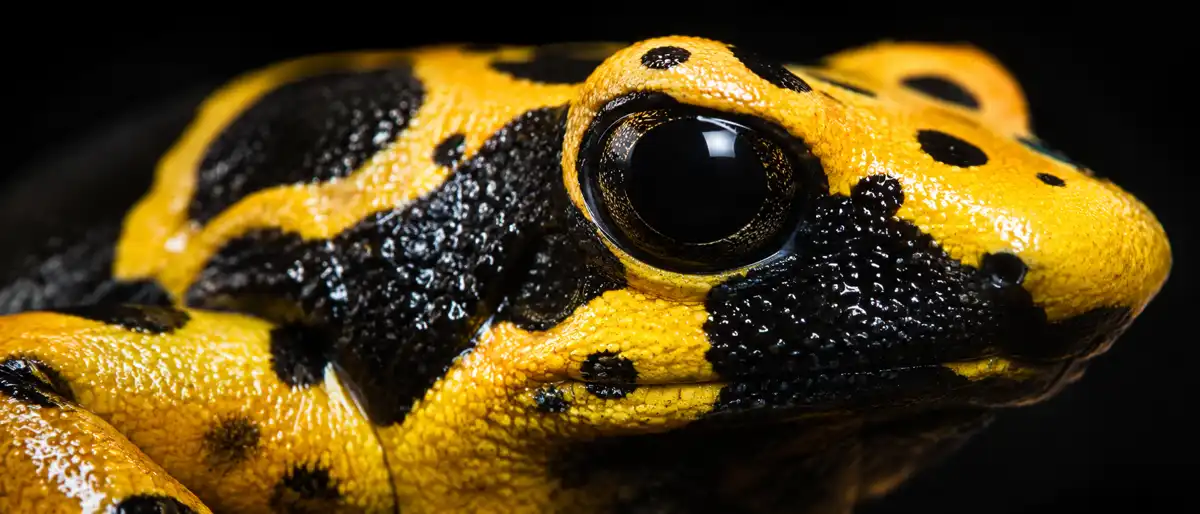
You probably think the poison dart frog is a naturally born biological weapon, something that evolved specifically to produce lethal venom from within its own body as a kind of built-in biochemical defense system, and this belief is exactly where most misunderstandings about poison dart frog toxicity begin.
You’re wrong.
These vibrant amphibians don’t actually produce a single drop of their own venom; instead, what they are doing is far closer to functioning as nature’s most efficient logistics managers, selectively outsourcing, collecting, storing, and redistributing toxic compounds that originate entirely outside of their own biology, almost as if their bodies were never meant to be factories at all but rather carefully engineered storage systems embedded inside a much larger ecological supply chain.
You might also believe that surviving the brutal terrors of the Amazon rainforest requires a small, thumb-sized creature to master camouflage and invisibility, blending into bark, leaf litter, and shadow in order to avoid detection.
Wrong again.
In the deepest, darkest corners of South America, the poison dart frog completely breaks that expectation by doing something that appears almost irrational from a survival standpoint, because instead of hiding it reveals itself openly, coating its body in neon, high-visibility coloration that seems almost designed to attract attention rather than avoid it, and then it places itself directly in the open where apex predators can easily see it, as if it is deliberately challenging the entire logic of predation with a kind of silent message that reads less like fear and more like absolute biological confidence: “Go ahead. Take a bite.”
And what makes this behavior so unsettling is that it is not bravado or illusion, but the visible expression of a survival strategy that has been refined over millions of years.
Here is the untold story of how a tiny frog appears to have hacked the basic assumptions of nature itself.
The Mind-Numbing Math of Batrachotoxin
To understand the reality of this creature, it helps to begin with a number that seems almost incompatible with intuition, because scientists estimate that just 0.2 milligrams of toxin associated with a Golden Poison Dart Frog (Phyllobates terribilis)—an amount lighter than a single grain of dust—is enough to kill an adult human.
This is one of the most extreme known expressions of poison dart frog toxicity in the natural world.
At this scale, the difference between life and death becomes almost invisible, yet the biological outcome is absolute.
A single frog in the wild may carry enough of this compound to disrupt the physiology of multiple large animals, and still there is no known antidote capable of reversing its effect once it enters the bloodstream.
At that point, the body is no longer regulating itself—it is simply continuing along a shutdown sequence it cannot interrupt.
But the real danger is not just potency. It is precision.
Hacking the Biological Operating System
The chemical responsible for this effect is batrachotoxin, a compound that does not destroy tissue in the conventional sense, but instead interferes with the electrical logic of the nervous system.
Every heartbeat, every movement, every breath depends on electrical signals traveling through nerve cells. These signals rely on voltage-gated sodium channels, microscopic structures that open and close in tightly controlled cycles to maintain electrical balance.
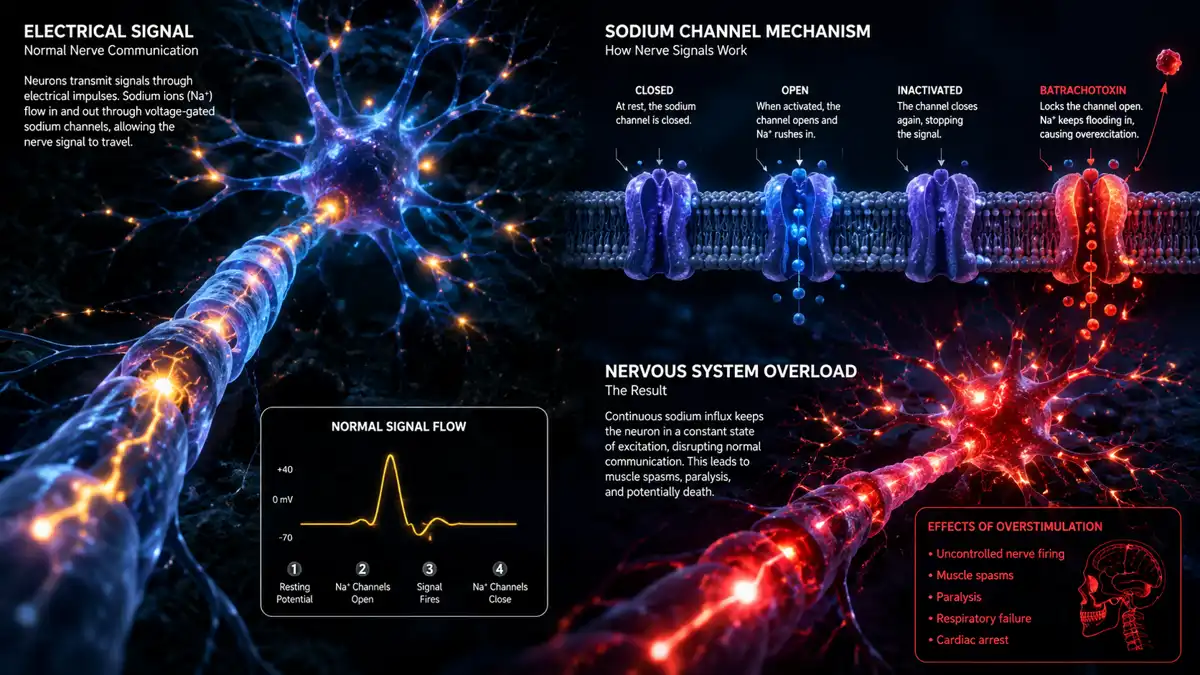
Normal nerve cell    → channels open/close normally → controlled electrical signaling
Disrupted nerve cell → channels locked open         → continuous sodium influx → electrical overload
Rather than acting like a typical poison, batrachotoxin behaves more like a system-level failure trigger. Once it binds to sodium channels, it forces them into an open state that cannot reset.
Sodium floods into nerve cells without regulation, collapsing the electrical gradient that sustains nervous system function.
What follows is a cascade: uncontrolled nerve firing, muscle spasms, loss of coordination, progressive paralysis, and finally failure of respiration and cardiac rhythm.
It is not destruction in the dramatic sense. It is system overload.
And this mechanism is the core of poison dart frog toxicity.
The Ultimate Contractor: A Poison Built on Dirt
Long before Columbus reached the Americas, indigenous hunters had already discovered that secretions from poison dart frogs could be used to coat blowgun darts, transforming simple tools into lethal delivery systems.
But this immediately leads to a deeper question that reshapes everything we understand about poison dart frog toxicity: where does the toxin actually come from?
To answer this, researchers raised highly toxic frogs in sterile laboratory environments, removing them from their natural ecological food web and feeding them a simplified, non-toxic diet of fruit flies.
Over time, something unexpected happened. Their toxicity faded and eventually disappeared.
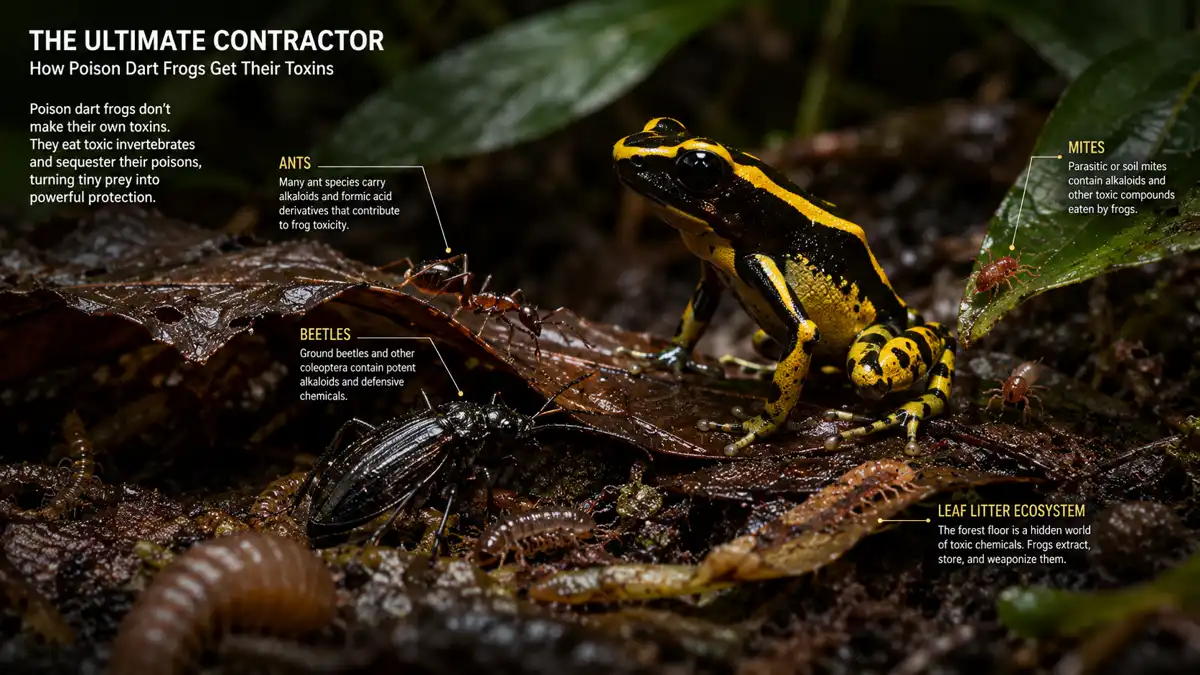
This revealed a fundamental truth: these frogs are not born toxic in a biochemical sense. Instead, they acquire their chemical defenses from their environment through a process known as toxin sequestration.
In the wild, they consume tiny leaf-litter arthropods—beetles, ants, mites, and millipedes—that themselves carry defensive alkaloid compounds.
Rather than breaking these compounds down, the frogs absorb and store them, routing them into specialized tissues beneath the skin where they accumulate into a defensive chemical layer.
In some cases, these compounds appear to be further modified inside the frog’s body, subtly transformed into more potent derivatives through enzymatic processes that are still not fully understood.
What emerges is not digestion in the traditional sense, but chemical repurposing at a biological level.
The Master Locksmith: Why They Don’t Poison Themselves
At first glance, it seems contradictory that an organism carrying compounds capable of disrupting nerve function can survive without self-destruction.
The answer lies in microscopic evolutionary changes in the frog’s own sodium channels—the same molecular targets affected by the toxin.
Through subtle genetic mutations, often involving a single amino acid substitution, the structure of these channels is slightly altered, changing the shape of the binding site.
This small modification is enough to prevent the toxin from interacting with the frog’s own nervous system in the same way it does in other species.
The result is a molecular mismatch: the toxin still exists, but it no longer fits its original target inside the frog.
Across different species, this resistance has evolved multiple times, creating layered protection against a range of alkaloid compounds rather than a single universal defense.
The outcome is a biological contradiction: an organism that carries lethal chemistry internally while remaining resistant to it through microscopic structural changes.
“Don’t Mess with Me”: The Power of Warning Colors
Once this chemical defense becomes reliable, camouflage is no longer the best strategy. Instead, evolution shifts toward communication. This is where aposematism—warning coloration in nature—becomes essential.
Rather than hiding, poison dart frogs broadcast their presence through extreme visual signals. Bright reds, deep blues, intense yellows, and sharply contrasting patterns all serve as ecological warnings.
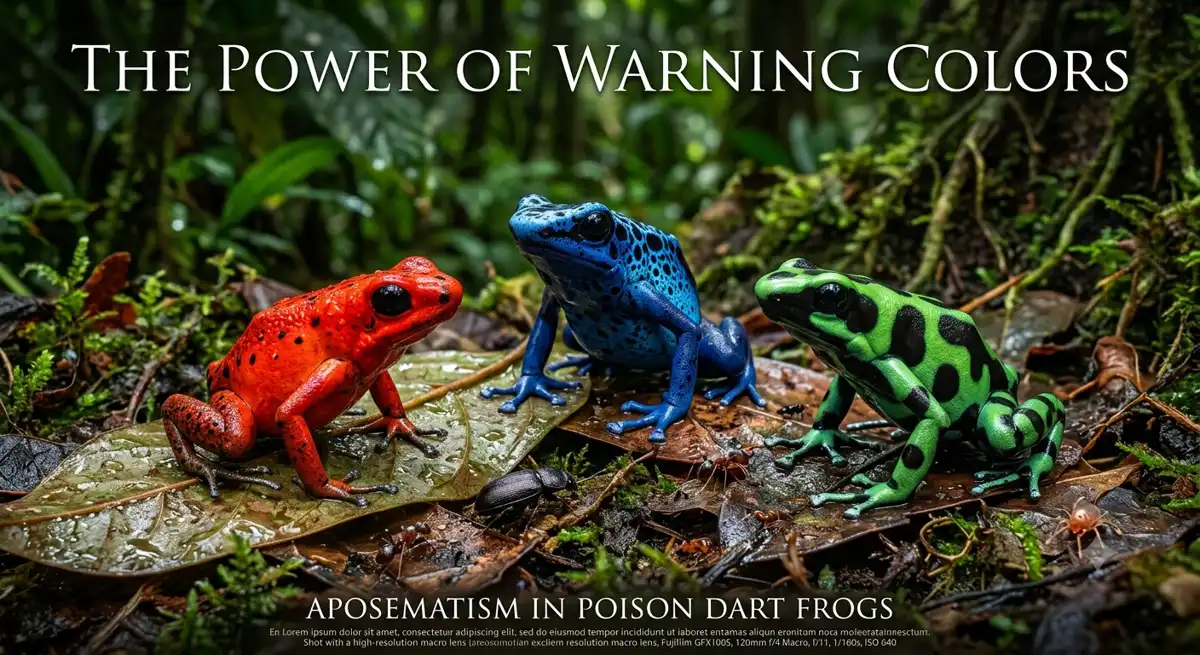
These colors communicate a simple message across species boundaries: this organism is not safe to consume.
Over time, predators learn this association through experience and inherited behavioral tendencies, creating a shared ecological understanding that bright coloration corresponds to danger.
In this way, poison dart frog toxicity becomes not only a chemical defense but also a visual language embedded in the rainforest ecosystem.
The Unending Arms Race
However, no evolutionary adaptation remains permanent.
In certain regions of the Amazon, some predators such as specific snake species have developed partial resistance to batrachotoxin, allowing them to consume poison dart frogs without immediate fatal consequences.
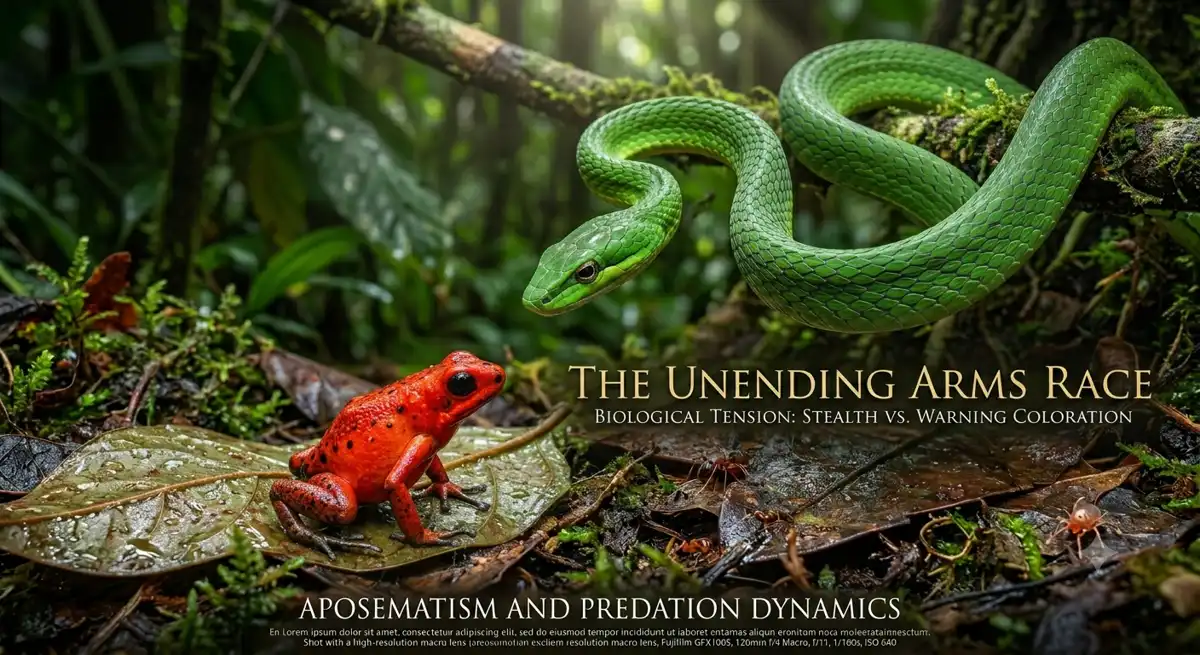
This resistance is not absolute immunity but a gradual shift in neural sensitivity that reduces the toxin’s effectiveness. In response, frogs diversify and intensify their chemical profiles, increasing variability in their defensive compounds.
What results is not a hierarchy of winners and losers, but a continuous feedback loop where each adaptation triggers a counter-adaptation.
Even some of nature’s most “perfect” defense systems have exceptions—similar to how the flounder, often described as the “Crooked-Face Celebrity” of the Ocean, evolved into a master of camouflage and survival in a completely different evolutionary direction.
Evolution does not stabilize here. It oscillates.
The Ultimate Evolutionary Takeaway
The story of the poison dart frog is not simply about toxicity—it is about transformation under constraint.
These animals did not evolve strength in the traditional sense. Instead, they evolved a way to incorporate environmental danger into their own biology and turn it into a functional defense system.
Poison dart frog toxicity is therefore not a single trait, but a layered system involving diet, chemistry, genetics, and behavior working together as one integrated survival strategy.
And what makes it especially compelling is that it overturns a simple assumption about nature: that survival depends on dominance.
Here, survival depends on integration.
A small organism does not overpower its environment—it reorganizes what it consumes into something that forces the environment to reconsider how it interacts with it.
And in that brief hesitation from predators—just long enough to avoid a fatal mistake—the frog continues to exist in a world that should, by all simple logic, have removed it long ago.