
Let’s start with an uncomfortable fact: your willpower is nowhere near as powerful as you think.
Most of us go through life assuming we’re the ones in charge. We decide what to eat, where to go, what career to pursue, and whether staying up until two in the morning is a terrible idea or a perfectly reasonable one. From the inside, consciousness feels like the ruler of the entire operation. It feels as though there is a central “you” sitting somewhere behind your eyes, making decisions and directing the body like a king issuing commands to loyal subjects.
But there is a surprisingly simple experiment that exposes the limits of that authority.
Hold your breath.
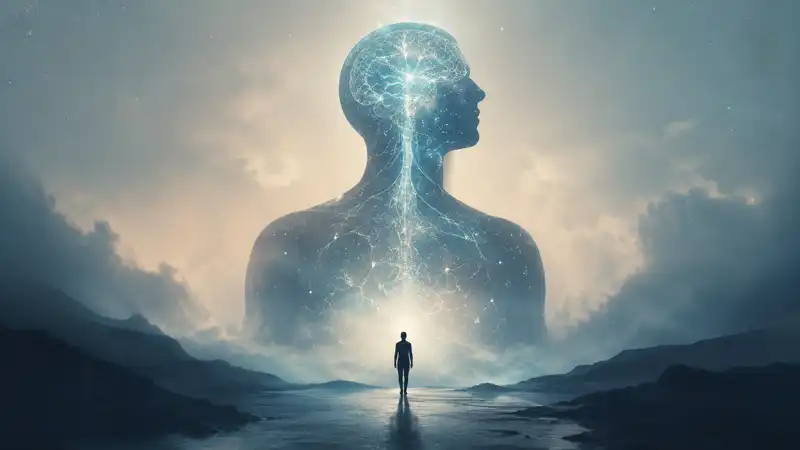
Not for ten seconds. Not for thirty. Keep holding it and see how far your determination can carry you. Sooner or later, you’ll run into an invisible wall. No matter how committed you are, no matter how strongly you insist, your body will eventually refuse to cooperate. And hidden inside that small act is the answer to a much larger question: who is actually running the human body?
The Real Power Structure Inside Your Head
To understand why can’t humans hold their breath to death, it helps to imagine the nervous system as a giant corporation.
The cranial nerves are the public relations department. They help manage many of the ways you interact with the world—seeing, speaking, hearing, smelling, and expressing yourself. The spinal nerves are more like logistics and communications, carrying information back and forth between headquarters and every distant corner of the body. Both departments are involved in things you can consciously notice and, to some extent, consciously control.
Then there is the autonomic nervous system.
This isn’t just another department buried somewhere on the organizational chart. It is the board of directors, the executive committee, and the administrative headquarters all rolled into one. It oversees the operations that never ask for your permission: heart rate, blood pressure, digestion, hormone regulation, temperature control, and breathing itself. If you’ve ever wondered why breathing is automatic, the answer is simple. The systems responsible for keeping you alive evolved long before conscious thought became part of the story. Survival could never depend on whether you remembered to inhale.
Within this headquarters sit two vice presidents with dramatically different management styles. One is a relentless workaholic who assumes every situation might become an emergency. The other specializes in recovery, maintenance, and conserving energy whenever possible. Together, they quietly influence almost every moment of your life.
The Workaholic Vice President and the Professional Slacker
The sympathetic nervous system is the workaholic.
Its specialty is what scientists often call the fight-or-flight response, though that phrase barely captures how much it does. Imagine scrolling through social media late at night and suddenly discovering that your ex just got married. Or realizing you’re already late for an important meeting. Or hearing an unexpected noise downstairs when everyone else in the house is asleep. Before your conscious mind has even finished processing the situation, your body is already moving into action. Your heart beats faster, your pupils widen, your palms become sweaty, and energy is redirected toward the muscles. The sympathetic system assumes speed matters more than discussion.
The parasympathetic nervous system approaches life very differently. If the sympathetic system is a caffeinated executive sending urgent emails at midnight, the parasympathetic system is the colleague reminding everyone to go home and get some sleep. It takes over during moments of rest and recovery. Think about the feeling of collapsing into bed after a long week, when your heartbeat slows, your breathing becomes calmer, your muscles loosen, and your eyelids begin to feel heavy. That isn’t laziness. It’s maintenance. The body is shifting resources away from emergency readiness and toward repair.
The important thing is that neither of these systems is particularly interested in your opinions. They are not waiting patiently for instructions from your conscious mind. In fact, they often act first and inform you later.
The Emperor Who Thinks He Rules Everything
A useful way to picture this relationship is through an old political metaphor.
Your conscious mind is like a newly crowned emperor. Young, ambitious, and completely convinced that the empire belongs to him, he assumes every order carries absolute authority. When he issues a decree, he expects it to be followed. When he speaks, he assumes the kingdom listens.
The autonomic nervous system, meanwhile, resembles an ancient bureaucracy that has been running the empire for centuries. It consists of experienced administrators who have survived countless rulers and countless crises. They allow the emperor to sit on the throne. They stamp his paperwork. They preserve the appearance that he governs everything. But behind the scenes, they are quietly following a much older set of rules.
Whenever the emperor issues a command that threatens the survival of the kingdom, the bureaucracy simply ignores him.
No dramatic rebellion.
No coup.
Just a quiet rejection followed by the activation of an emergency plan.
This is why questions about consciousness vs body control become so fascinating. The deeper you look, the harder it becomes to determine where real authority actually resides.
The situation becomes even stranger when you start examining consciousness itself. Most of us automatically identify with the voice in our heads—the running narrator that comments on our lives and feels like our true self. But that voice may be only one part of a much larger system. (Related: The Voice in Your Head: Where It Comes From—and How to Live With It)
The Moment Your Body Stops Listening
Now let’s return to the breath-holding experiment.
At first, everything seems fine. You stop breathing and feel almost nothing. The emperor has issued an order, and the kingdom appears obedient. For the first several seconds, there is little reason to think the arrangement won’t continue indefinitely.
Then, somewhere around the thirty-second mark, the first signs of resistance begin to appear. A slight pressure develops in your head. Your temples may start to pulse. Your chest becomes more noticeable. Nothing dramatic has happened yet, but the bureaucracy has started filing complaints.
By around a minute, carbon dioxide levels in the bloodstream have risen significantly. Many people assume the urge to breathe comes from a lack of oxygen, but in reality the accumulation of carbon dioxide is often the more important trigger. Deep within the brainstem, specialized respiratory centers constantly monitor these changes. This is a key part of how the brain controls breathing, and once certain thresholds are reached, increasingly urgent signals begin flooding the system.
The message is simple.
Breathe.
Immediately.
At this point, people sometimes ask: can you stop breathing voluntarily? The answer is yes, but only temporarily. Consciousness can delay the process. It cannot permanently overrule it. The emperor has limited veto power, but he does not control the emergency protocols.
If you continue resisting, the situation escalates. Vision may begin to narrow. Dizziness can appear. The body starts preparing for more aggressive intervention. And if you somehow push beyond your limits, consciousness itself may shut down.
That is the crucial detail most people overlook.
The survival system removes the emperor before the kingdom runs out of options.
The moment you lose consciousness, the autonomic nervous system takes full control. Your airway opens, your lungs resume their normal rhythm, and breathing returns automatically. The body does not negotiate. It simply executes the procedure it was designed to perform.
That’s ultimately why humans cannot hold their breath to death. The conscious part of the mind loses authority before the body loses the ability to breathe.
Your Body Might Not Belong to You
By now, a strange realization begins to emerge.
Your body may not be something you own in the way you imagine.
You have access.
You have influence.
You have certain privileges.
But ownership is another matter entirely.
The same principle appears everywhere. You cannot consciously command your heart to stop beating. You cannot decide to dilate your pupils. You cannot order yourself to grow several inches taller by next week or persuade your hair follicles to become more productive overnight. There are entire layers of biological reality operating beneath awareness, carrying out tasks without consultation.
It’s a bit like choosing what to have for dinner. You can decide between barbecue and hot pot. You can choose where to sit and who to invite. What you cannot do is rewrite the laws governing metabolism while you’re eating.
The kingdom grants authority, but only within certain limits.
The Same Problem Appears in Mental Health
This perspective also sheds light on something many people struggle to understand about anxiety and depression.
There is a common belief that emotions should respond directly to willpower. If you’re sad, cheer up. If you’re anxious, relax. If you’re overwhelmed, stop worrying. Yet these suggestions often fail for the same reason you cannot simply command your heart to skip a beat. Much of human experience emerges from systems operating below conscious awareness, including hormones, neurotransmitters, and countless biological processes that don’t respond to motivational speeches.
If people could control their internal chemistry through determination alone, heartbreak would be optional and anxiety disorders would barely exist. Unfortunately—or perhaps fortunately—the body does not grant that level of authority to the conscious mind.
The People Who Seem to Bend the Rules
Of course, there are always exceptions that make the story more interesting.
Some people can deliberately trigger goosebumps. Certain actors seem capable of crying on command. Advanced practitioners of meditation, breathing techniques, or yoga have demonstrated unusual influence over processes that most of us experience as automatic. There are even reports of individuals entering states resembling deep absorption or flow, where awareness and bodily regulation appear to interact in unexpected ways.
Whether these abilities represent genuine control over parts of the autonomic nervous system or simply a greater capacity to influence it remains an ongoing question. Either way, they occupy a fascinating edge case—one that feels almost like a biological version of a superpower.
But that’s a different conversation.
Perhaps Your Body Loves You More Than You Do
What makes all of this strangely moving is the realization that your body has been protecting you long before you understood what protection meant.
The ancient systems operating beneath consciousness do not care about your social status, your career plans, your unfinished goals, or your philosophical debates. They are not concerned with your romantic disappointments or your existential crises. Day after day, year after year, they continue carrying out instructions written deep within your biology, following survival algorithms refined across millions of years of evolution.
You may panic.
You may make foolish decisions.
You may occasionally act against your own interests.
The system underneath responds with remarkable consistency.
It simply refuses to let the kingdom fall.
In that sense, there is something almost romantic about the relationship between consciousness and the body. All the authority we believe we possess exists within boundaries established by a much older intelligence. It is silent, tireless, and largely invisible, yet it follows a single rule with unwavering dedication:
No matter how much the emperor misbehaves, the kingdom must survive.
And perhaps that leaves us with the most interesting question of all. When you say “I,” who exactly are you referring to? The conscious voice reading these words right now, or the ancient biological machinery that has been quietly keeping you alive this entire time?
Maybe the greatest illusion isn’t that we’re in control.
Maybe it’s that we ever thought we were.