
Hey everyone, it’s your old friend here—just a regular science buff who loves letting my mind wander. In my spare time, I love pondering those “what if” scenarios, like “What if the dinosaurs never went extinct?” or “What would happen if a black hole swallowed the moon?” Today, I want to take you on a wild ride to discuss a much more extreme, mind-bending scenario: What would happen if all the sun’s light focused on a single point and hit one person with pinpoint accuracy?
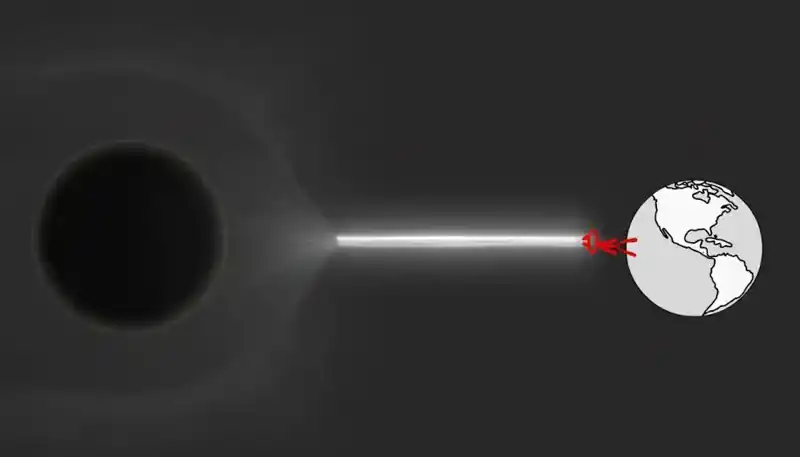
This sounds like a plot from a sci-fi movie, but let’s use some basic physics to deduce the consequences of this “concentrated solar attack.” Don’t worry, I’ll keep it in plain English—no textbook boredom here.
1. The Setup: A Data Warm-up
First, let’s crunch some numbers. Did you know that the solar energy Earth receives every day is approximately 1.5×10^22 Joules? (Yep, that’s an astronomical figure). And the energy the Sun releases every second is 25,000 times that amount! Imagine the Sun as a super power plant, constantly spewing out heat and light.
If this energy were spread evenly across the Earth like usual, we’d get about 21 times more solar energy than we do now—basically turning the globe into a giant sauna. But now, we are leveling up the game: all that sunlight is aimed like a laser pointer, precisely at one person. This Solar Energy Focusing Effect would instantly turn that person into what? The answer is: a cloud of high-energy particles! Yes, you heard that right. Under this type of Extreme Solar Radiation, the human body would be vaporized so fast there wouldn’t even be ash left. Terrifying, right?
2. The First Wave: Fireball Explosion and Earth Weeps
Okay, the main character is gone. Let’s look at the supporting actor—Earth itself. Assuming this person is standing at a specific point (say, New York or Beijing, doesn’t matter), that “Super Solar Beam” will hit the atmosphere first. The result? The air is instantly heated to millions of degrees Celsius! This temperature is hotter than the surface of the Sun (which is only about 6,000 degrees).
The impact point will immediately form a giant Fireball, with a scale and power far exceeding humanity’s strongest hydrogen bomb explosion. You know the mushroom cloud from the atomic bomb in Hiroshima? This fireball would be a version tens of thousands of times bigger.
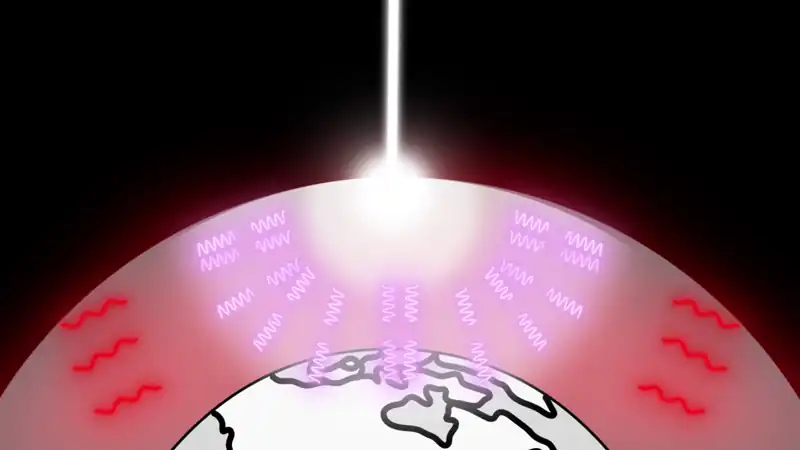
As soon as the fireball pops up, it starts “spreading.” It releases high-energy X-rays that spread outward like bullets. These rays pierce through the air, continuing to heat everything around them. The fireball’s range expands rapidly, but the temperature drops slightly as it grows. Next, lower-energy Infrared Rays take over, rolling out with residual heat. Everything along the path—buildings, forests, oceans—gets vaporized. The crust can’t handle it either; it cracks and melts, and the scene of Earth’s Crust Destruction begins to play out. The half of the Earth facing the beam basically becomes scorched ruins.
3. The “Safe Zone” on the Other Side? Don’t Be Naive
Earth has a diameter of about 12,700 km, pretty big, right? So, the half facing away from the beam (like if you were in the Pacific Ocean exactly opposite the impact point) is safe for now. People there won’t be roasted immediately; they might even have time to tweet: “Hey, why didn’t the sun rise today?”
But don’t celebrate too early. Their doomsday isn’t coming from a frontal attack, but from something with a poetic name—The Dawn.
What is this dawn? Not the romantic morning light! The Skyglow Phenomenon (or scattered light) is usually the pale blue halo formed by the atmosphere scattering sunlight when the sun is below the horizon. But here, it transforms into a killer.
The fireball’s X-rays and infrared rays will spread along the edge of the atmosphere, ionizing the air into high-temperature, high-pressure Plasma (think super-hot ionized gas). Plasma is “transparent” to X-rays, so the rays can easily pass through, igniting more atmospheric regions. These new regions turn into plasma too, releasing their own thermal radiation. Most of the heat will escape into outer space, but a portion gets trapped in the atmosphere, spreading like a chain reaction.
The Result? A Heat Radiation Fireball Storm will sweep across the globe. People on the other side of Earth will see a “Hellish Dawn” appear on the horizon—not a gentle pink, but a scorching orange-red glow with temperatures high enough to instantly evaporate everything. The process of Atmospheric Ionization and Thermal Radiation Diffusion will turn the entire planet into an oven.
4. The Moon’s “Counter-Kill”: The Deadly Reflection
Wait, there’s a variable that makes things even more dramatic: Moon Phases!
If it happens to be a Waning Crescent (where the moon is just a sliver), people on the other side of Earth might feel lucky—because the moon would suddenly “turn off the lights.” Why? All the sunlight is concentrated in the beam, so the moon’s surface goes pitch black instantly.
However, the fireball at the impact point will shine like a lighthouse, illuminating the surface of the moon. When the moon casts this reflected light back to the dark side of the Earth… BOOM! The intensity of the Moon Reflecting Solar Light would be enough to obliterate everything there. Trees catch fire, oceans boil, and humans are instantly carbonized. Before the fireball even has time to lap the Earth, the other side is already “GG” (Game Over).
Conversely, if it were a Full Moon or First Quarter Moon, the moon’s reflection of normal sunlight is weak anyway, and now that it’s gone, the other side might breathe a sigh of relief. But regardless, the Moon Phase Influence on Solar Radiation Reflection is an interesting plot twist that adds a touch of uncertainty to this scenario.
5. Earth’s “Escape”: Orbit Saves Most of the Home
Luckily, Earth isn’t a sitting duck; it moves! Earth travels around the Sun at a speed of about 30 km/s. About 7 minutes after the beam hits, Earth will be able to “sidestep” out of the attack range.
The destruction time is greatly shortened. Although the facing side is burnt to a crisp, the mechanism of Earth’s Orbital Escape from Solar Beams allows the vast majority of land and oceans to survive. Earth will carry its scars and start a “wandering journey”—broken but not destroyed, continuing to revolve around the Sun.
Think about it: those short 7 minutes determine the survival of billions of lives. The role of Earth’s rotation and revolution in disasters is truly a clever design of nature.
Epilogue: The Sun’s Gentleness and Rage
Phew, closing the “brain hole” now! This story of “all sunlight focused on one person” is just a product of scientific imagination, but it reminds us: Solar Energy is a double-edged sword. Usually, it warms all living things; in the extreme, it can destroy heaven and earth.
Thanks to the laws of physics, we live in balance. Next time you’re sunbathing, don’t forget to appreciate this “moderation.” If you enjoy this kind of Extreme Astronomical Event Simulation or science communication about the Impact of Solar Radiation on Earth, leave a comment and share your own “What If” scenarios! See you next time, as we continue to explore the wonders of the universe.
Further Reading: Can You Really Dodge a Bullet by Jumping into Water? Science Says Yes—With Conditions