

Imagine a surgeon touching the surface of your brain while you are awake, and feeling nothing more than pressure or movement rather than pain. It sounds almost impossible, especially because the brain is the organ that allows you to experience pain in the first place. Yet the basic idea is true: the brain tissue itself does not contain nociceptors, the specialized sensory receptors responsible for detecting potentially damaging stimuli and initiating nociceptive signals. This unusual fact is one reason certain neurosurgical procedures can be performed while a patient is awake; after the skull and other pain-sensitive tissues around the brain have been anesthetized, the brain tissue itself can be touched or stimulated without producing the ordinary sensation of pain.
And yet, almost everyone has experienced a headache. Sometimes it is a dull pressure behind the eyes; sometimes it feels as if something is tightening around the entire skull. A migraine can be even more dramatic, bringing intense throbbing pain, sensitivity to light and sound, nausea, and a feeling that even ordinary movement makes everything worse. So if the brain itself cannot feel pain, what exactly is hurting when you have a headache?
Can the Brain Feel Pain?
To answer that question, it helps to separate two things that we normally treat as the same: nociception and pain. Nociception is the nervous system’s detection of potentially harmful stimuli, while pain is the conscious experience that emerges when the nervous system processes and interprets those signals. The two are closely connected, but they are not identical.
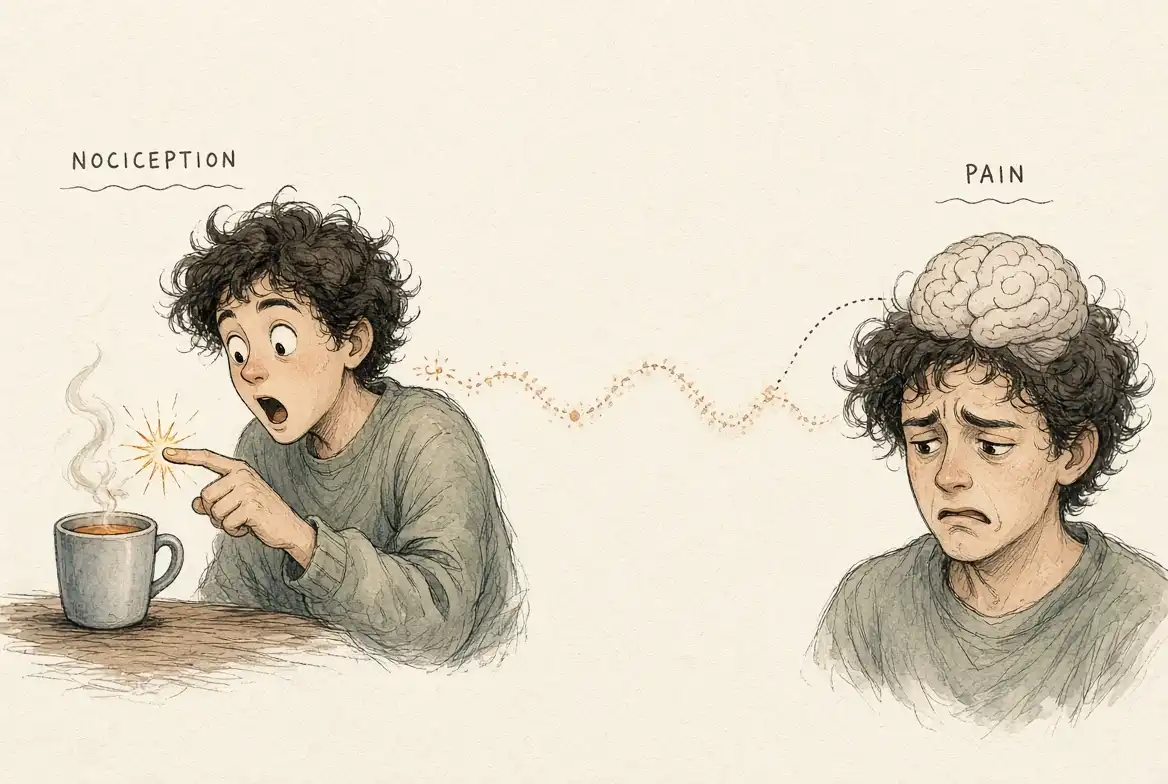
This distinction explains the strange relationship between the brain and pain. Your brain is where pain ultimately becomes a conscious experience, but the brain tissue itself does not need pain receptors to perform that job. Think of a fire-alarm system: smoke detectors sense the danger, electrical wiring carries the information, and a control room interprets the signal and tells everyone that something is wrong. The control room does not need to be burning for the alarm to work. In a similar way, the brain receives signals from pain-sensitive structures elsewhere in the body and turns those signals into the experience we recognize as pain.
So when you ask, “Can the brain feel pain?”, the answer is more precise than a simple yes or no. The brain can process pain, interpret pain, and create the conscious experience of pain, but the brain parenchyma itself does not contain the nociceptors that would allow the tissue to directly sense its own injury.
If the Brain Doesn’t Hurt, Why Do Headaches Hurt?
The brain is not sitting naked inside your skull. It is surrounded by several layers of protection, including the meninges, cerebrospinal fluid, and the skull itself, while an extensive network of blood vessels supplies the tissue with oxygen and nutrients. Many of the structures surrounding the brain contain pain-sensitive nerve fibers, which means that irritation or activation of these structures can generate powerful headache signals even though the brain tissue itself cannot directly feel them.
The dura mater, the tough outer layer of the meninges, is particularly important because it is richly supplied by sensory fibers associated with the trigeminal nervous system. Blood vessels inside the skull can also be surrounded by pain-sensitive nerve fibers, while structures in the scalp, face, jaw, and neck can contribute to certain types of headache. In other words, the sensation we casually describe as “brain pain” usually originates from the tissues around the brain rather than from the brain tissue itself.
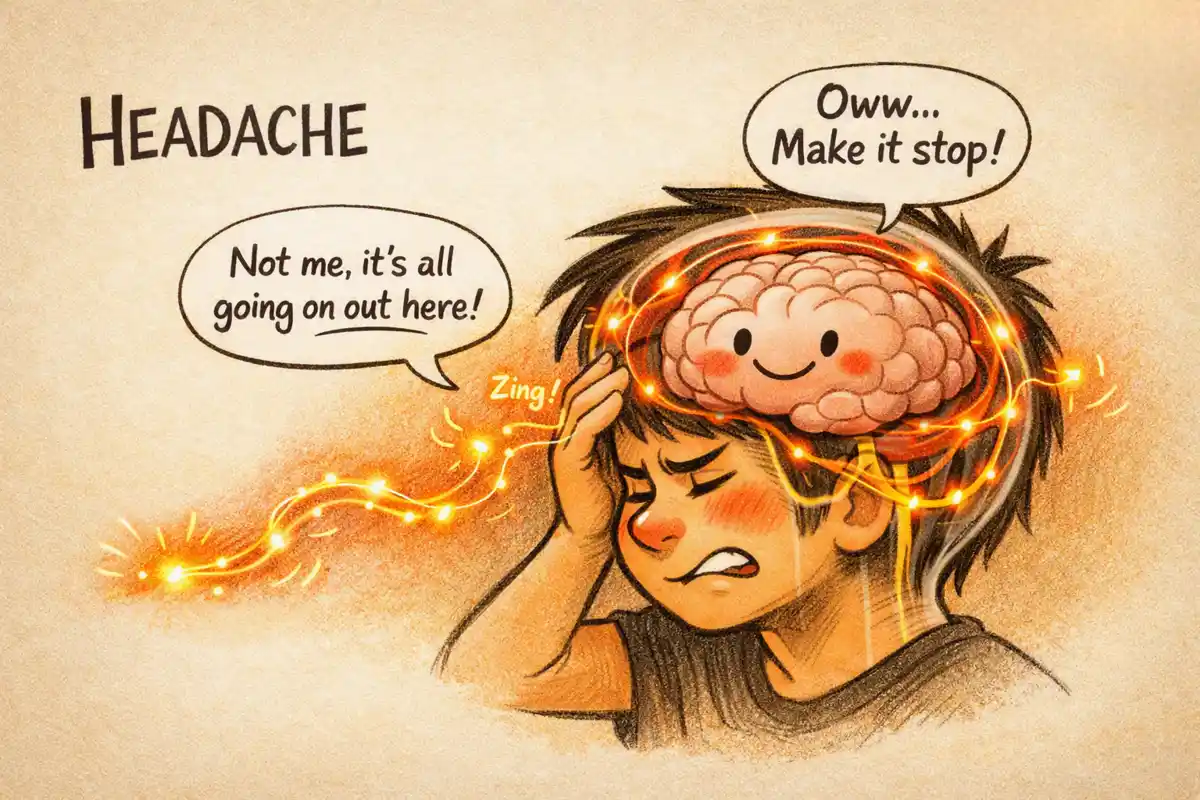
When you say, “My brain hurts,” what is actually happening is more complicated. Signals are being generated by pain-sensitive structures in and around the head, carried through sensory pathways, and processed by the nervous system until they become the conscious experience of a headache. The brain does not need to hurt in order for you to feel pain in your head; in fact, the brain is the organ that turns those incoming signals into the experience of pain.
What Causes Migraine Pain?
Migraine makes this paradox even more interesting because the old explanation of migraine as nothing more than blood vessels expanding and contracting is far too simple. Modern neuroscience points to a much more complicated interaction involving nerves, blood vessels, inflammatory signaling, and the way the brain processes sensory information.
One of the central players is the trigeminovascular system, a network involving branches of the trigeminal nerve and blood vessels in structures such as the dura mater. When this system becomes activated, it can produce the intense headache pain associated with migraine. Another important molecule is calcitonin gene-related peptide, or CGRP, a neuropeptide that plays a major role in migraine biology and has become an important target for modern migraine therapies.
This is why migraine is better understood as a neurological and neurovascular process rather than simply a problem with blood vessels. The trigeminal nerve can transmit pain signals from structures around the brain, chemical messengers such as CGRP can contribute to the process, and the central nervous system ultimately processes all of that information into the experience of a migraine.
The result is another biological paradox: the brain tissue itself has no nociceptors, yet the brain is where the incoming signals become the experience of pain. It does not need to feel the pain itself; it only needs to understand what the pain signals mean.
Why Doesn’t the Brain Have Its Own Pain Receptors?
At first glance, this seems like a terrible design decision. The brain is arguably the most important organ for everything we experience, so why would evolution leave it without its own emergency pain alarm?
The answer becomes more interesting when we consider what pain is actually for. Pain is fundamentally useful because it changes behavior. Touch a hot pan and your hand hurts, so you pull it away. Step on something sharp and your foot hurts, so you stop putting weight on it. Pain warns the body that tissue may be under threat and encourages a protective response before the damage becomes worse.
The brain has a very different problem. It is already enclosed within a hard biological fortress, protected by the skull, meninges, and cerebrospinal fluid. Unlike a hand or foot, the brain cannot simply move itself away from danger. If an external force is strong enough to directly damage the brain tissue itself, the situation is already extremely serious, and a pain signal from the brain tissue would not provide the same kind of useful withdrawal response that it does when your hand touches a hot surface.
That does not mean the brain is incapable of producing pain signals when something goes wrong around it. Quite the opposite: the tissues protecting the brain are equipped with sensory pathways that can detect potentially damaging changes and send warning signals into the nervous system. The alarm does not have to be inside the thing being protected. Sometimes it is enough to put the detectors around it.
The Blood-Brain Barrier Is a Selective Fortress
The brain has another unusual relationship with the rest of the body. It sits behind the blood-brain barrier, a highly selective interface that controls what can move between the bloodstream and the central nervous system.
The name makes it sound like an impenetrable wall, but that is not quite accurate. The blood-brain barrier is better understood as a sophisticated biological filter. Neurons are extremely sensitive to their chemical environment, so the brain cannot simply allow everything circulating through the blood to wander freely into neural tissue. Some substances cross relatively easily, while others are restricted or require specific transport mechanisms.
The same principle applies to the immune system. The brain is not an immune-free zone, nor is it completely sealed away from the body’s defenses. Immune cells and inflammatory signals can interact with the central nervous system under certain conditions, particularly during infection, injury, or disease. The important point is that the brain operates within a tightly regulated immune environment rather than being exposed to the bloodstream in the same unrestricted way as many other tissues.
In a sense, the brain is not isolated from the rest of your body; it is carefully separated from it.
Who Cleans the Brain? Meet the Microglia
That raises another obvious question. If the brain exists in such a carefully controlled environment, who deals with damaged cells, cellular debris, and the constant remodeling of neural circuits?
Part of the answer is microglia, the resident immune cells of the central nervous system. Unlike immune cells that primarily circulate through the bloodstream, microglia live within the nervous system and continuously monitor their surroundings. When they detect injury, infection, or other disturbances, they can change their behavior, remove cellular debris, and participate in inflammatory and repair processes.

Microglia are also involved in remodeling connections between neurons, including processes associated with synaptic pruning. During brain development, the nervous system produces an enormous number of neural connections, and some are later weakened or removed as neural circuits become more refined. This does not mean that a microscopic cell wanders through your brain and decides, “You haven’t thought about that childhood friend lately—delete.” Memory is far more complicated than that, involving constantly changing networks rather than isolated files stored in one location.
Still, the underlying idea is remarkable: your brain is not a finished machine. It is constantly being maintained, modified, reorganized, and cleaned. Even while you sit perfectly still reading this article, microscopic processes inside your head are changing the structure and activity of the neural networks that allow you to think, remember, feel, and experience the world.
The Organ That Knows What Pain Feels Like
Step back for a moment and consider what the brain actually does. The human brain weighs roughly 1.3 to 1.5 kilograms, yet it consumes a remarkable share of the body’s energy. It sits in a dark, enclosed space surrounded by bone and fluid, connected to the rest of the body by an immense network of nerves and blood vessels.
It receives information about light, sound, temperature, pressure, movement, hunger, balance, and pain. It can recognize a face you have not seen in twenty years, hear a song and suddenly pull a forgotten summer back into consciousness, and transform a complicated mixture of electrical and chemical signals into the simple realization that something hurts.
Yet the brain tissue itself does not directly feel that pain.
That may be the strangest part of all. The brain is the organ that helps you experience the world, but its own tissue does not experience pain in the way your skin, muscles, or other pain-sensitive tissues do. It is almost like a control room that receives every emergency call in the building but has no smoke detector of its own.
When your hand touches fire, the alarm begins in your hand. When pain-sensitive structures around the brain are irritated or activated, the alarm can begin there. The message travels inward, and the brain receives it. Then, through an extraordinary combination of neural activity, chemical signaling, and sensory processing, that collection of signals becomes a simple sentence inside your head:
“That hurts.”
The brain itself does not have to scream. It only has to understand the scream.
And that may be one of the strangest truths about the organ responsible for almost everything you experience: the organ that teaches you what pain feels like is also the one organ whose own tissue cannot directly feel it.
Further Reading: Why Can’t Humans Hold Their Breath to Death?