

If you had to guess which takes longer to poop—a house cat or an African elephant—you would probably pick the elephant. It weighs thousands of kilograms, has a much larger digestive system, and produces vastly more feces. Surely, getting all that material out must take longer.
Not necessarily.
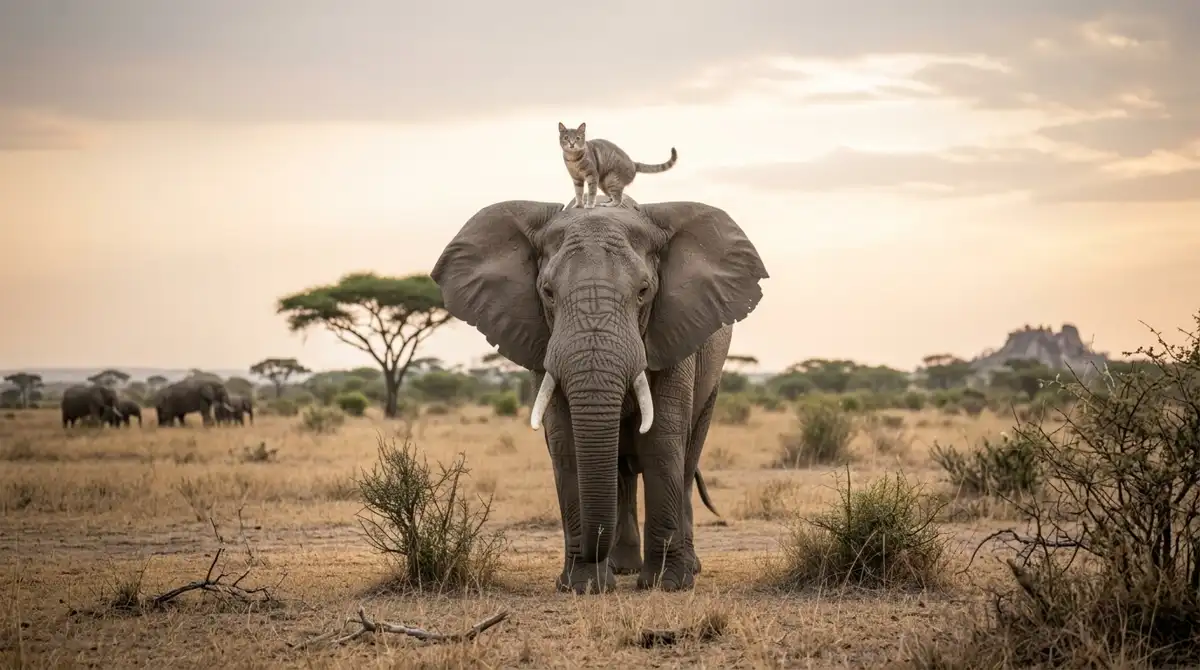
Scientists who actually timed mammals found something surprisingly consistent. Across 23 mammal species studied in a 2017 experiment, the average defecation time was about 12 seconds, with a variation of roughly ±7 seconds. An elephant may produce far more poop than a cat, but that doesn’t mean it needs dramatically more time to get rid of it.
Yes, someone really did watch animals poop for science.
How Long Does It Take an Elephant to Poop?
The famous 12-second figure comes from a study published in Soft Matter in 2017 by researchers at the Georgia Institute of Technology, including Patricia Yang and David Hu. Their paper, Hydrodynamics of Defecation, looked at the surprisingly complicated physics behind one of the most ordinary things mammals do.

The researchers studied 23 mammal species, including elephants, giant pandas, warthogs, dogs, and humans. They combined observations with measurements of rectums and feces, examined the physical properties of mucus and fecal matter, and used mathematical models to understand how material moves through the final part of the digestive tract.
The result was one of those wonderfully strange scientific findings: rectum lengths varied from roughly 4 to 40 centimeters, yet defecation times remained surprisingly similar. Larger animals weren’t simply taking longer to push much larger amounts of feces out. Their bodies had other ways of compensating for their size.
Why Do Animals Poop So Fast?
The key is that body size changes several parts of the system at once.
Larger animals tend to produce longer fecal masses and expel them at higher speeds. An elephant, for example, can eject feces at around 6 centimeters per second, several times faster than the speeds measured in smaller mammals such as dogs and humans. That extra speed helps offset the greater distance and volume involved.
It is a little like traffic on a highway. A highway carries far more cars than a narrow country road, but it also has more space and allows traffic to move faster. Looking only at the amount of traffic would give you a misleading picture of how long the journey takes.
Animal defecation works on a similar principle. The anatomy, the material being moved, and the forces involved all scale together. A large mammal isn’t simply a small mammal with every part enlarged; its entire system is adapted to work at a different scale.
And that brings us to the strangest part.
The Secret Is Mucus
Your digestive tract isn’t a dry pipe, and neither is an elephant’s. The intestinal lining produces mucus that creates a slippery layer between feces and the intestinal wall, reducing friction and helping the fecal mass move toward the exit.
The researchers found that this mucus layer plays an important role in making defecation efficient. Feces are relatively resistant to flow, while the mucus surrounding them acts as a lubricant. Larger animals also tend to have thicker mucus layers, helping them deal with their much larger fecal masses.
Nature has, essentially, built a biological waterslide.
The speed of defecation therefore isn’t simply a matter of strong muscles. It depends on a combination of factors, including the dimensions of the rectum, the properties of the feces, the thickness of the mucus layer, and the forces used to push everything along.
That is why the question why do elephants poop so fast has a much more interesting answer than you might expect. The elephant isn’t winning some contest of muscular determination. Its entire digestive system is designed to move material efficiently at elephant scale.
Why Would Animals Benefit From Pooping Quickly?
There may also be an evolutionary advantage to getting the job done efficiently. In the wild, defecation temporarily puts an animal in a less mobile and potentially more vulnerable position. It can also leave behind odors that other animals may detect.
That doesn’t mean predators are the reason mammals evolved a roughly 12-second average. The study does not establish such a simple cause-and-effect relationship. But minimizing the time spent in a vulnerable position is a plausible advantage, particularly for animals that need to stay alert to their surroundings.
An animal doesn’t have to consciously think, “I should hurry because there might be a leopard.” If being slightly quicker improves survival often enough, natural selection can do the rest.
Still, this is a side note. The main explanation is physics.
What About Constipation and Diarrhea?
The 12-second figure is an average, not a biological stopwatch.
The consistency of feces matters. The researchers found that looser feces, such as those associated with diarrhea, can be expelled more quickly, while harder feces associated with constipation take longer. The basic reason is fairly intuitive: material that flows more easily requires less effort to move.
So animal defecation time depends on more than body size. Fecal consistency, lubrication, intestinal geometry, pressure, and expulsion speed all contribute to the final result.
And if your personal record is nowhere near 12 seconds, don’t worry.
There is no official elephant leaderboard.
Then There’s the Human Problem
Humans make this whole subject considerably less straightforward.
The physical act of defecation is only part of the time we spend in the bathroom. We have private rooms, doors that lock, comfortable seats, and smartphones. A person can sit down intending to spend two minutes in the bathroom and somehow emerge twenty minutes later after scrolling through a feed they never intended to open.
An elephant has none of these distractions.
It doesn’t have Wi-Fi.
That distinction matters when people ask how long does it take to poop. The biological process and the amount of time someone spends sitting on the toilet are not necessarily the same thing. Animals are dealing with a physical problem. Humans have somehow turned it into a leisure activity.
The Animal Solved the Physics. Humans Added a Phone.
The 12-second finding doesn’t mean elephants, cats, dogs, and humans have identical digestive systems. Quite the opposite. Their anatomy and body sizes are dramatically different.
What the research shows is that those differences can be balanced by changes elsewhere in the system. Bigger animals have bigger fecal masses, but they also have larger anatomy, thicker mucus layers, and faster expulsion speeds. Smaller mammals move less material, but their entire system operates on a smaller scale.
The result is a surprisingly similar timescale.
It is a neat example of a broader principle in biology: size changes everything, but not necessarily the final outcome.
Something as ordinary as defecation turns out to be a small lesson in fluid dynamics, anatomy, and evolutionary design. The next time you think an elephant must spend ages in the bathroom, remember that its enormous digestive system has already solved a problem that looks much harder than it really is.
Nature optimized the exit.
Humans optimized the excuse to stay.
Further Reading: Why Animals Seek Salt: The Quiet Force That Shapes Wild Behavior