
In the heart of Chicago’s Roscoe Village, a seemingly ordinary sidewalk slab has captured the world’s imagination. What started as a quirky snapshot of a Chicago Roscoe Village cement rat print exploded into a global phenomenon, drawing pilgrims, wedding vows, and endless memes. Dubbed the “Chicago Rat King,” this enigmatic imprint—complete with tiny paws and a slender tail—sparked a frenzy of speculation. But one year later, science has stepped in to reveal the Chicago cement rat hole truth: it’s not a rat at all. It’s a squirrel. Buckle up as we dive into this tale of urban folklore, viral fame, and a surprising biological twist.
The Birth of a Sidewalk Superstar: How the Chicago Rat King Went Viral
Picture this: It’s January 2024, and Chicago comedian Winslow Dumaine is strolling through Roscoe Village, a charming neighborhood known for its cozy cafes and tree-lined streets. He snaps a photo of a fresh-poured cement patch on the sidewalk, where an eerily perfect Chicago Roscoe Village cement rat print stares back at him. The imprint looks like a rodent mid-leap—front claws splayed, hind legs tucked, and a whip-like tail dragging behind. Dumaine posts it on X (formerly Twitter) with a cheeky caption: “Had to make a pilgrimage to the Chicago Rat Hole.“
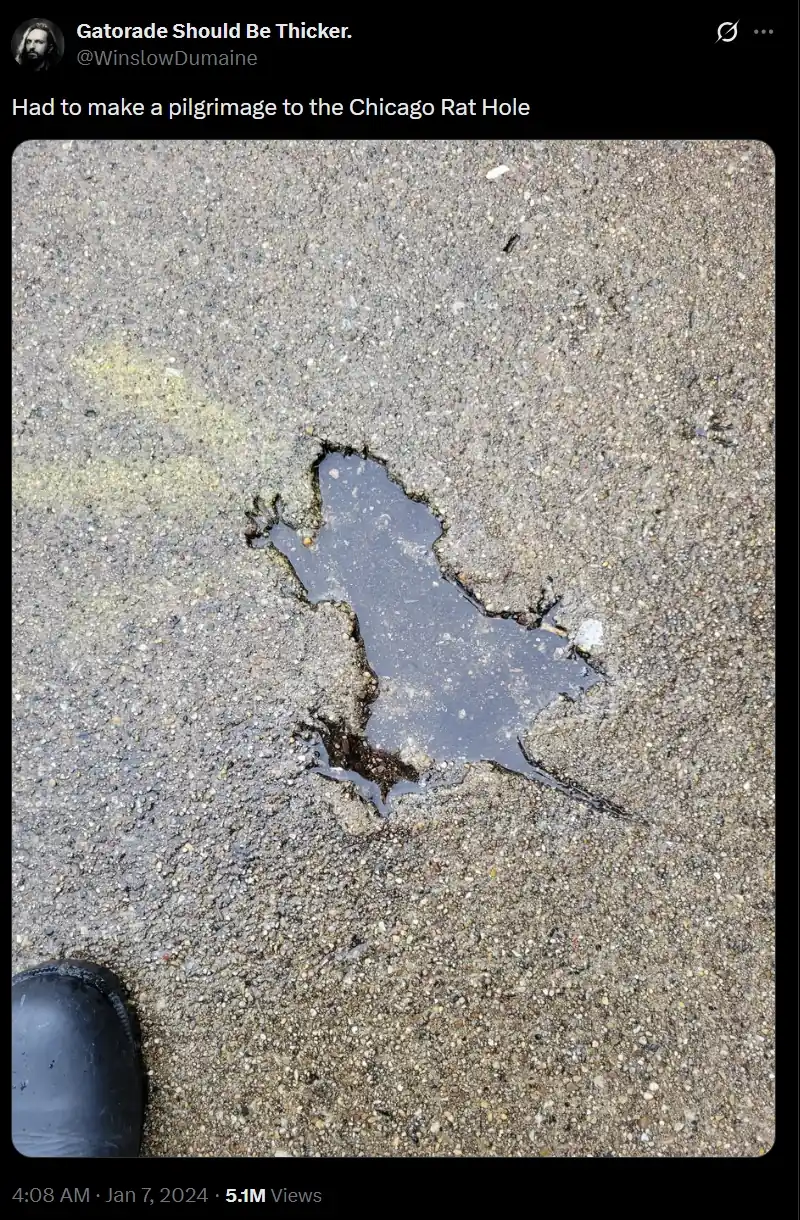
The internet did what it does best: it ignited. Within days, the post racked up over 5 million views, thousands of likes, and shares from celebrities. Tourists flocked to the site at Damen Avenue and Roscoe Street, turning a humble sidewalk crack into a pilgrimage spot. People tossed coins into the print for good luck, staged elaborate photo ops, and one couple even exchanged vows right there, declaring it their “rat-romantic” venue. The local community got in on the fun, launching a naming contest that crowned the creature the “Landed Rat King.” Chicago’s mayor chimed in on social media, vowing to preserve the spot as a “city treasure.” For a moment, the Chicago Rat King wasn’t just a print—it was a symbol of the city’s resilient, rat-infested charm, blending humor with the everyday absurdity of urban life.
This viral wave highlighted something universal: our love for the bizarre. In a world of polished influencers and scripted content, a gritty Chicago cement rat hole felt raw and real. It reminded folks of childhood wonder—spotting fairy rings in the grass or animal tracks in the snow. But beneath the laughs lurked a question: What really made this mark?
The Science Strikes Back: Exposing the Chicago Cement Rat Hole Truth
Fast-forward to October 2025, and the party crashes with a peer-reviewed bombshell. A team from Northwestern University, led by biologist Dr. Elena Vasquez, published their findings in Communications Biology. Their verdict? The Chicago cement rat hole truth is far fluffier than anyone imagined: 98.67% probability points to a gray squirrel, not a notorious house rat. What began as a lighthearted meme morphed into a rigorous study of urban wildlife and forensic footprint analysis.
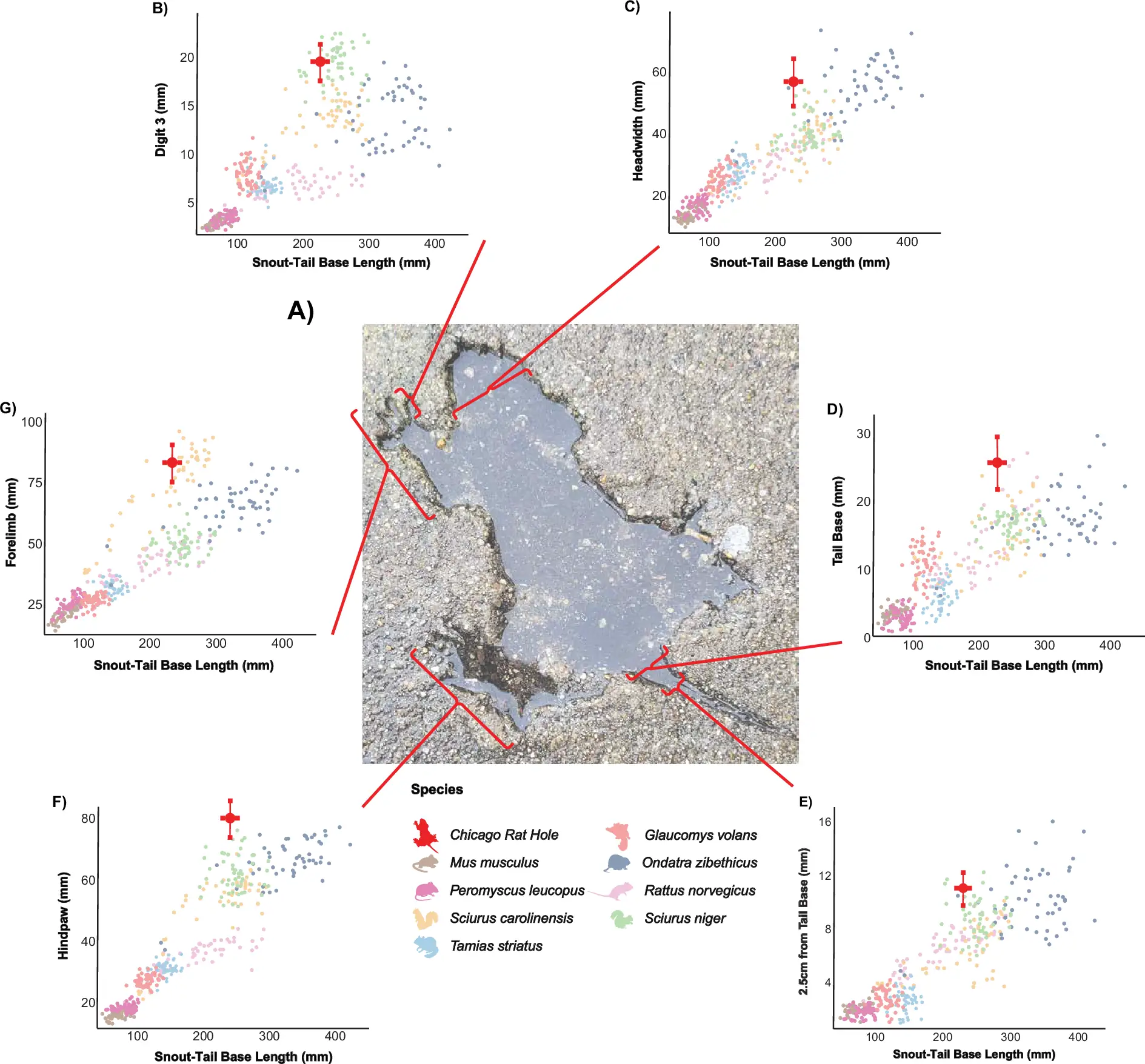
The researchers zeroed in on two glaring clues at the scene. First, the isolation: No entry or exit tracks marred the surrounding cement. A rat would’ve scampered across it, leaving a trail of chaos. Second, the anatomy didn’t quite fit. While the print mimicked a house rat’s silhouette—especially that telltale skinny tail—the overall size was off, clocking in larger by about 20%. Crucially, the front paws lacked the prominent thumb claw typical of rodents; instead, they matched the stubby, clawless thumbs of sciurids (that’s squirrels to you and me), evolved for gripping bark, not burrowing.
To crack the case, Vasquez’s team didn’t rely on hunches. They compiled biometric data from 37 Chicago-native species, focusing on seven metrics: paw dimensions, tail drag patterns, limb ratios, and more. Using 3D modeling and statistical matching, they pitted the print against suspects like rats, opossums, and raccoons. House rats? Eliminated—too small and clawed. Opossums? Too bulky. Enter the eastern gray squirrel (Sciurus carolinensis), the urban acrobat that nailed every criterion with near-perfect alignment.
But they didn’t stop at stats. Contextual evidence sealed the deal. Cement in Chicago is typically poured during daylight hours and sets by nightfall, per city records. Rats, being nocturnal, would’ve avoided the fresh mix like the plague. Squirrels, however? Diurnal daredevils, leaping from branch to branch in broad daylight. Eyewitness accounts from longtime Roscoe Village residents added the cherry on top: That slab’s been there for 20 years, right beside a now-removed oak tree. The theory? A bushy-tailed jumper misjudged a glide 20 years ago, belly-flopping into the wet concrete with a splat that echoed through time.
As for the “rat tail”? The rough texture of the aggregate likely snagged only the tail’s bony core, erasing fuzzy details. No fur, no problem—it just made the print look more rodent-y. This blend of forensics, ecology, and a dash of detective work turned the Chicago Rat King from folklore into a teachable moment on misidentification in urban biodiversity.
Why the Chicago Rat King Still Captures Hearts (Squirrel or Not)
You’d think the reveal would deflate the hype, but nah—the internet’s too resilient for that. Social media lit up with puns like “Squirrel King dethrones Rat Royalty!” and fan art of a crowned acorn-muncher. The site still draws crowds, now with signs nodding to the science: “Home of the True Chicago Rat King… er, Squirrel Supreme.”
At its core, this story’s about more than a mistaken mammal. It’s a snapshot of how we humans latch onto the unexplained, weaving myths from mundane mishaps. In Roscoe Village, that Chicago Roscoe Village cement rat print bridged the gap between city grit and natural whimsy, proving science can enhance the magic rather than spoil it. Next time you’re pounding Chicago’s pavements, keep an eye on the ground. Who knows? Your own Chicago cement rat hole discovery might just go viral—tail and all.
The Chicago Rat King’s Last Hurrah—From Street Corner Icon to Dusty Museum Relic
The Chicago Rat King story didn’t just vanish after all the buzz died down. A couple months later, on April 24, 2024, the folks at the Chicago Department of Transportation (CDOT) showed up with their tools. They said it was just your basic fix-up job—the sidewalk was getting all cracked and sketchy, so someone could trip and sue the city into next week. But here’s the cool part: they didn’t just smash it to bits like any old chunk of concrete. Nah, the crew took their time and carefully cut out that whole square slab, Chicago Roscoe Village cement rat print included, treating it like some ancient artifact they didn’t want to scratch.
Right now, it’s chilling in a government storage spot, tucked away safe and sound behind locks and red tape. Nobody’s locked in where it’ll end up for good, but word on the street from Roscoe Village regulars—and big shots like the Chicago History Museum—is that it’s got a pretty good shot at landing in a display case. Picture this: years from now, you’re wandering the exhibits, and there it is, under a spotlight, labeled as this weird slice of “city oddball vibes.” A squirrel’s goofy tumble stealing the show from the Bean or whatever. Kinda wild, right?
If you swing by Damen and Roscoe these days, though? It’s just a boring stretch of brand-new, bland concrete—flat and forgettable, like a tweet that never took off. The Chicago cement rat hole? Poof, gone from the pavement. No more chucking quarters in for luck or snapping selfies with the fam. It’s swapped that gritty street energy for quiet shelf space in some archive. Hell, the “Rat Hole” went from pop-up art everyone could touch to this fancy, official keepsake that basically puts a bow on the whole tale. Shows you how, in a place like the Windy City, even the tiniest goof-up can stick around and make waves forever.