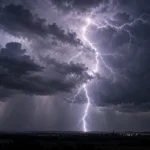

Picture a lightning strike. A jagged white line drops out of a dark cloud, hits the ground, and vanishes in a blink. The direction seems obvious: lightning comes down from the sky.
Except the brightest part of a typical cloud-to-ground strike travels the other way.
The flash you see is only one stage of a much faster sequence. A faint channel develops downward, electrical channels reach upward to meet it, and a brilliant pulse races through the completed path. Asking whether lightning goes up or down is a little like asking which way a conversation travels. You have to know which part you are watching.
Before the Flash, a Storm Separates Its Charges
A thundercloud is electrically active long before a visible bolt appears. Inside it, rising air carries small ice crystals upward while larger particles, including graupel—small, soft hail particles—move differently through the storm. Collisions between these particles transfer electrical charge. As air currents and gravity separate them, regions with different charges build up inside the cloud.
A common arrangement places the main region of negative charge in the middle of the storm, with positive charge higher up. Real thunderstorms can have more complicated structures, including a smaller positive region near the cloud base. These charge differences create intense electric fields. Under suitable conditions, the air breaks down electrically and a discharge begins, although exactly how lightning gets started remains an active area of research.
Not every discharge heads toward the ground. Much of a storm’s lightning connects charged regions inside the cloud. The dramatic bolt striking a tree or lighting up a city skyline is only one possible outcome of the electrical activity overhead.
The First Path Down Is Surprisingly Faint
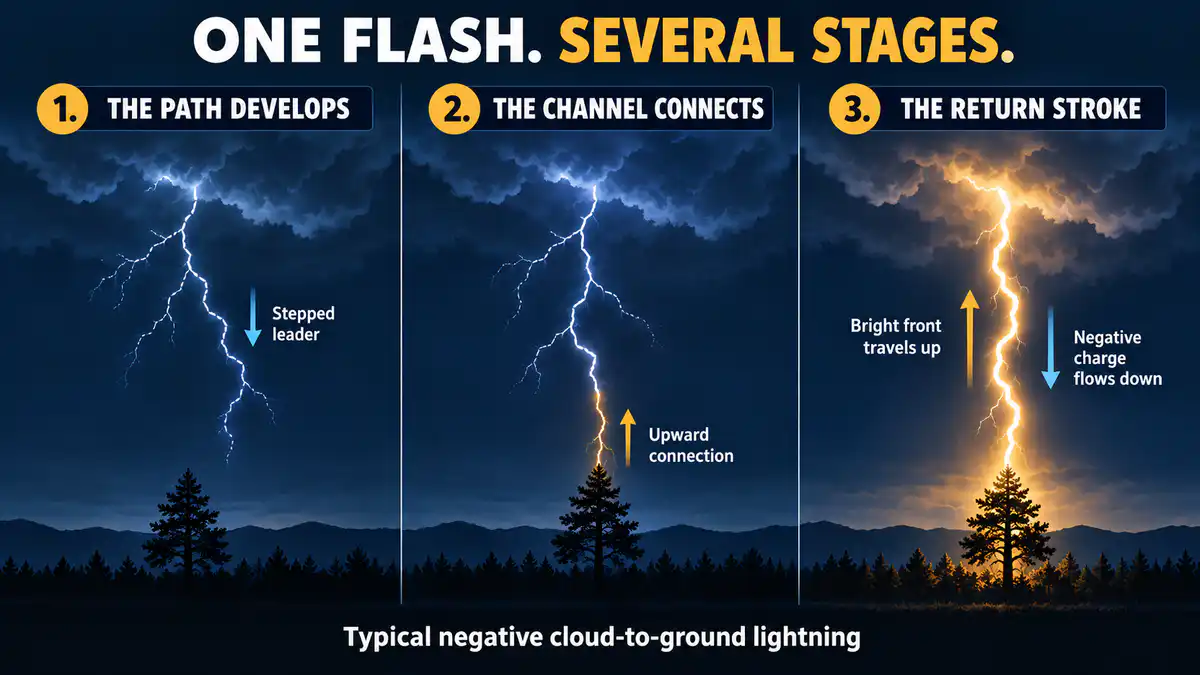
In the most common type of cloud-to-ground lightning, a negatively charged channel begins extending toward the surface. Scientists call it a stepped leader.
It does not move in one smooth sweep. Instead, it advances in short, sudden steps, branching as it goes and creating the crooked, forked shape we associate with lightning. Each growing tip responds to the electric field in its immediate surroundings. The leader is not aiming at a particular tree or building from the moment it leaves the cloud; its route develops as it progresses.
This stage produces light, but it is relatively faint. High-speed cameras can capture the stepped movement. Our eyes usually cannot separate it from the much brighter flash that follows. By the time you notice the bolt, much of the work of building its path has already happened.
The Ground Reaches Up to Meet It
As the stepped leader approaches the surface, the electric field around nearby objects intensifies. Upward electrical channels, often described as upward streamers, can develop from trees, rooftops, poles, and other objects beneath the descending branches.
Several may develop as the leader approaches. A successful connection between an upward channel and a descending branch completes a conducting path between cloud and ground.
Here is where the familiar picture starts to break down. A lightning bolt does not simply land on a passive surface. In the final moments before the brilliant flash, electrical activity is developing from both directions. The cloud-to-ground connection is completed by a brief meeting that happens too quickly for us to notice.
Why the Brightest Part Travels Upward
Once the connection forms, a powerful return stroke lights up the channel. Its bright front propagates upward, following the path the leader has already created.
This is the part that fools us. The direction in which the channel lights up is different from the direction in which negative charge moves.
The bright return-stroke front travels upward, while negative charge flows toward the ground.
In a typical negative cloud-to-ground flash, charge begins draining rapidly through the completed connection. The process starts at the lower end of the channel and progresses upward, making successive sections intensely luminous. The National Weather Service explains this distinction in its guide to the lightning return stroke.
Imagine a line of cars waiting at a traffic light. When the light turns green, the first car moves forward, then the one behind it, then the next. Every car travels forward, but the point where movement begins works its way backward through the queue. The return stroke involves very different physics, but the analogy helps separate the direction of movement from the direction in which that movement spreads.
The bright front can travel at roughly 100,000 kilometers per second—about a third of the speed of light. Actual speeds vary, but the scale explains why we see a sudden white line rather than a channel lighting up from bottom to top. The sequence is there. Our eyes simply cannot resolve it.
One Flash Can Contain Several Strokes
Even the brilliant flash may contain more than one stroke.
After the initial return stroke, the channel can remain conductive long enough for another leader to travel downward along much of the same path. This subsequent discharge is called a dart leader. Another return stroke can follow, and the sequence may repeat within a fraction of a second. A typical negative flash often contains an initial return stroke followed by two or three more, although some contain only one and others have more than a dozen.
These repeated strokes help explain why lightning sometimes appears to flicker. What looks like a single restless bolt can be a rapid series of discharges using much of the same channel. High-speed footage stretches the event into a sequence we can inspect: downward development, connection, upward illumination, and sometimes another cycle.
Some Lightning Really Does Begin on the Ground
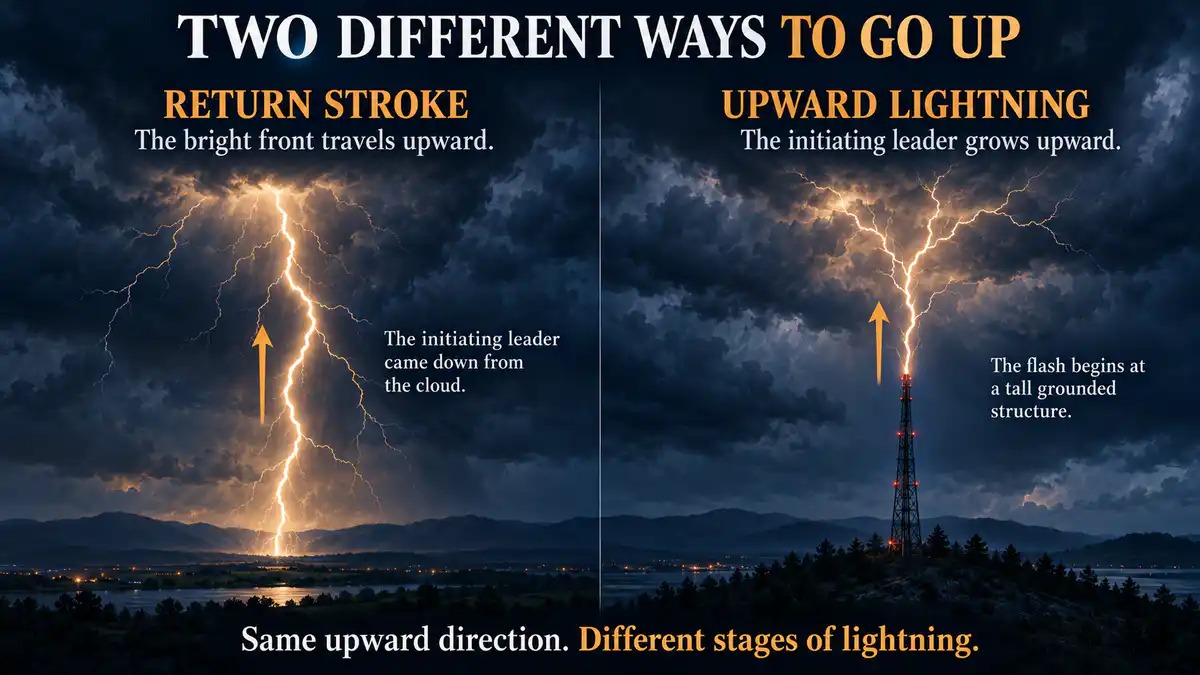
So far, we have been talking about the upward-moving bright front of an ordinary downward flash. There is also lightning whose initiating leader genuinely starts near the ground.
This is upward lightning, and it is different from a return stroke.
In downward cloud-to-ground lightning, the initiating leader develops from the cloud toward the surface. In upward lightning, a leader begins at a tall grounded object, such as a tower or skyscraper, and grows toward the sky. The distinction concerns where the flash begins, rather than which way its brightest stage appears to move.
Upward flashes are often triggered by nearby lightning that suddenly changes the electric field around a structure. Under suitable conditions, some can also begin without a preceding flash. NOAA’s National Severe Storms Laboratory describes these events in its overview of lightning types.
A branching channel growing out of a tower may therefore show something fundamentally different from the upward illumination of an ordinary return stroke. Both involve upward development, but at different stages of the electrical event.
So, Does Lightning Go Up or Down?
Both, depending on the type of flash and the stage you are watching.
In a typical negative cloud-to-ground flash, the stepped leader develops downward. An upward electrical channel completes the connection, and the bright return-stroke front then travels upward while negative charge flows toward the ground. In upward lightning, the initiating leader itself starts at a grounded structure and grows toward the sky.
The surprising answer is not that lightning always goes up. It is that the single white line we notice contains several processes with different directions. Our eyes compress them into one apparently simple event, leaving us with a convincing picture of something we have only partly seen.
Oddbbo Insight
Lightning feels easy to understand because its shape is so familiar. Slow the event down, and that white line becomes a sequence: a faint path building downward, an upward connection reaching to meet it, and a brilliant front racing back through the completed channel.
The sky did not reverse its rules. We were simply never given enough time to see them.
Further Reading:Types of Volcanoes: The Many Faces of Earth’s Fiery Fury