

Here is some science-based information about healthy eating.Today, let’s talk about a common phenomenon: why do red stool or urine appear after eating red-fleshed dragon fruit? This is actually caused by a natural pigment in dragon fruit called betanin. It is not easily broken down during digestion, thus affecting the color of excretions. Below, we will explain step by step the entire journey of food from ingestion to excretion based on digestive physiology, and how betanin “dyes” it. The whole process usually takes 30 to 40 hours.
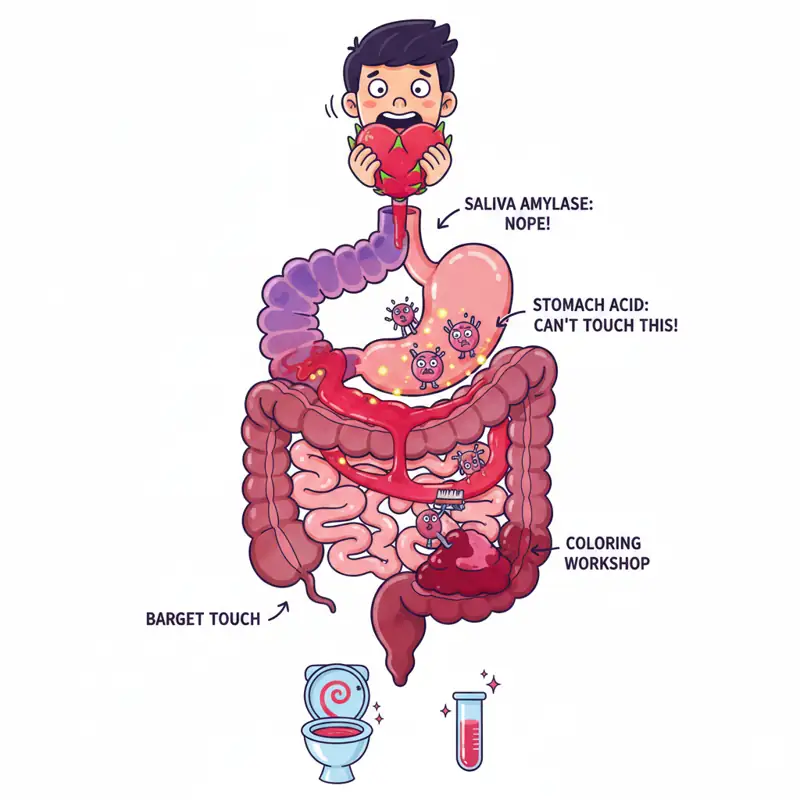
Oral Stage: Initial Mixing
When you eat red-fleshed dragon fruit, the chewing process mixes the pulp with saliva to form a bolus. The human body secretes about 1.5 liters of saliva per day, which contains amylase. This enzyme can initially break down the starch in food, converting it into simple maltose. However, it has no effect on betanin, which is the key component causing the color change.
The bolus then enters the stomach through the esophagus, a process that takes only a few seconds.
Gastric Stage: Initial Breakdown
In the stomach, food stays for 3 to 4 hours. Here, through the stomach’s contractions and peristalsis, the food is further broken down and thoroughly mixed with gastric juices. The pH of stomach acid is about 1 to 2, which is highly acidic and can dissolve certain substances while killing potential pathogens. At the same time, stomach acid activates pepsin to help break down proteins, preparing for subsequent absorption.
However, none of these processes can destroy the structure of betanin, so it proceeds to the next step intact.
Small Intestine Stage: Nutrient Absorption
The semi-liquid food (called chyme) enters the small intestine, which is about 5 to 6 meters long and has an internal surface area of 30 to 40 square meters. This is the primary site for digestion and absorption. Digestive juices secreted by the pancreas, liver, and other organs break down carbohydrates, fats, and proteins, while the villi on the small intestine wall absorb over 90% of the nutrients and water.
Betalin does not participate in these metabolic processes; most of it enters the large intestine along with the residue. A small amount may be absorbed into the bloodstream and filtered out by the kidneys, causing the urine to turn red.
The residue includes dietary fiber, undigested remnants, and intestinal bacterial metabolites, all of which cannot be absorbed and proceed to the large intestine.
Large Intestine Stage: Water Absorption and Stool Formation
The large intestine is about 1.5 meters long and wider in diameter than the small intestine. Its main functions are to absorb remaining water and shape the stool. If food passes through the large intestine too quickly, insufficient water is absorbed, resulting in looser stool; if too slowly, excessive water absorption leads to harder stool.
Betalin distributes evenly in the stool, causing it to appear red. Ultimately, the stool is expelled from the body through the rectum and anus.
Reasons for Color Variations
Not everyone experiences the same color change after eating red-fleshed dragon fruit. This depends on several factors:
- Digestion Speed: Shorter transit time through the intestines means less water absorption, resulting in brighter colors; longer time means more water absorption, leading to deeper colors.
- Intestinal Microbiota: Each person’s intestinal bacteria types and quantities differ. Some bacteria may slightly break down betanin, lightening the color; those with weaker breakdown ability show more pronounced colors.
Benefits of Betanin
Betalin is harmless to the human body and is a natural antioxidant that promotes health. Dragon fruit itself is rich in dietary fiber, vitamins, and minerals, with dietary fiber helping to promote intestinal peristalsis and maintain gut health.
In summary, this color change is a normal physiological phenomenon and nothing to worry about. If you’ve had similar experiences, feel free to eat more dragon fruit to enjoy its nutritional benefits. If you experience persistent discomfort, please consult a doctor.
Further Reading: 2025 Nobel Prize Reveals How the Immune System Protects Itself