
There is one question I keep coming back to, and the more I think about it, the stranger it becomes.
Why did the universe allow life to appear at all?
At first glance, the answer seems obvious. Given enough time, enough stars, enough planets, and enough chemical reactions, life was bound to happen somewhere. We are simply the lucky outcome of an unimaginably large cosmic lottery.
But that explanation has never completely satisfied me.
A universe governed only by the laws of physics doesn’t actually need life. It can expand, cool, form galaxies, burn through stars, and eventually fade into darkness without a single living creature ever opening its eyes. Everything would still work exactly as the equations predict. In fact, it would probably be a much simpler universe.
Yet life appeared anyway.
Not just simple organisms quietly floating through ancient oceans, but creatures capable of fear, love, curiosity, and the peculiar habit of staring into the night sky asking, Why am I here?
The deeper you follow that thought, the more unsettling it becomes. If life was merely an accident somewhere along the universe’s timeline, why did it eventually produce memory, consciousness, and the endless desire to search for meaning? A rock never questions its existence. A galaxy never wonders where it came from. Somehow, matter eventually learned to ask questions about itself.
I’m not going to explain how DNA replicates or walk through a textbook version of evolution. Instead, I’d like to follow a different trail—one that begins with several recent scientific discoveries but eventually leads somewhere much larger.
Not toward a definitive answer, because science doesn’t have one yet, but toward a possibility that has become increasingly difficult for me to ignore.
The Story Didn’t Begin With Life
Before we can ask why life exists, it’s worth looking at what happened long before the first cell ever appeared.
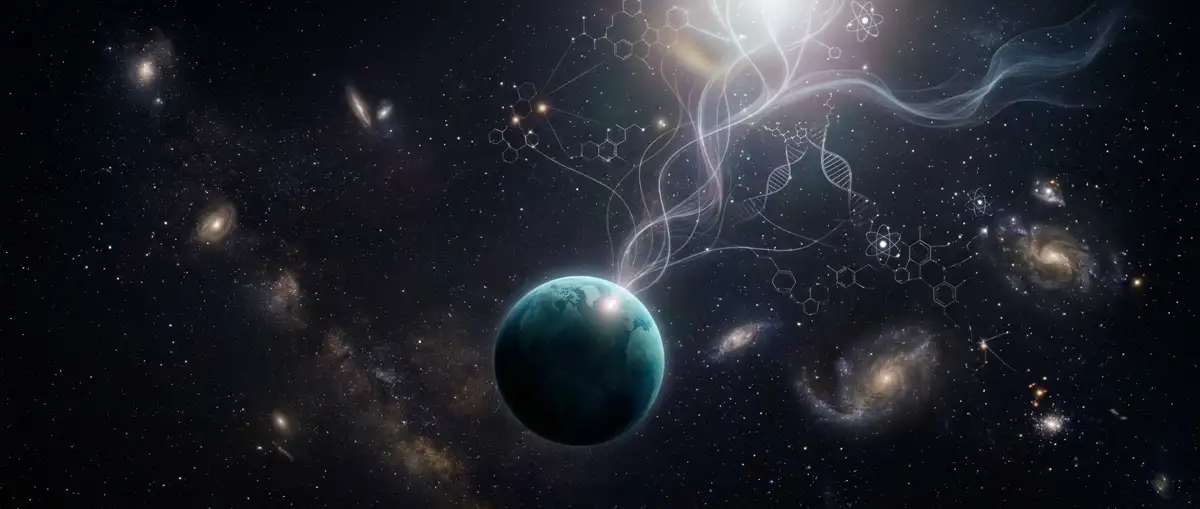
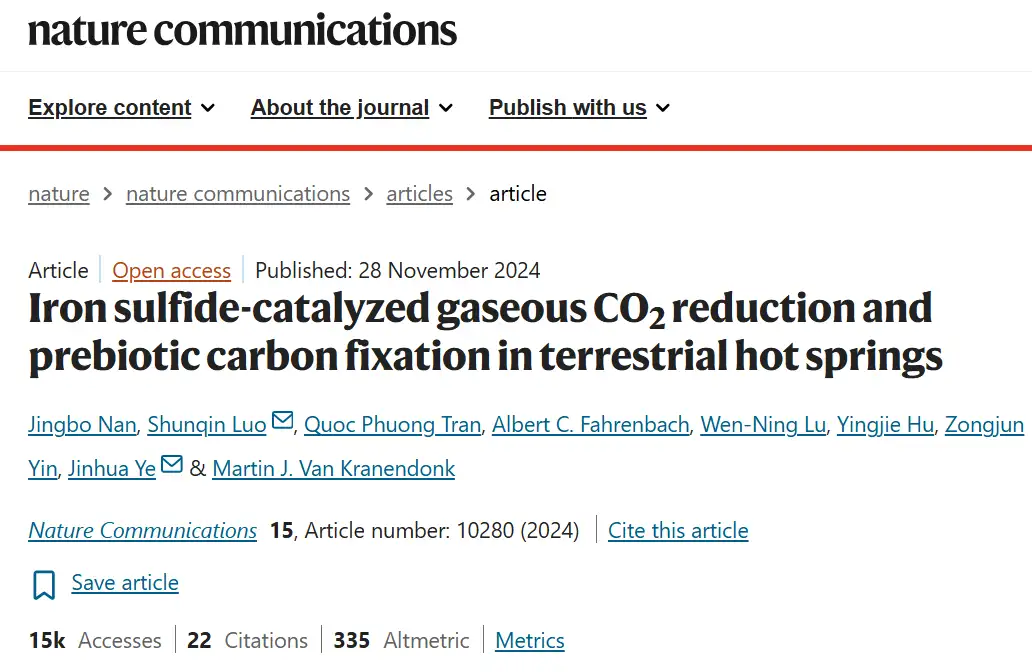
In late 2024, a research team from the Chinese Academy of Sciences published a study suggesting that some of the earliest building blocks of life may have formed in hot spring environments on the young Earth. Their experiments showed that iron sulfide minerals, driven by heat and light, could convert carbon dioxide into methanol—one of the simple organic compounds that may have helped kick-start prebiotic chemistry. It doesn’t prove exactly how life began, but it does make one thing feel much less mysterious: the seemingly lifeless Earth may have been quietly preparing the ingredients long before biology arrived.
Only a month later, another study caught my attention for a completely different reason.
Scientists at Nanjing University assembled one of the most comprehensive reconstructions of early eukaryotic life ever produced, tracing roughly 1.5 billion years of biological history. Instead of revealing a smooth march toward increasingly advanced organisms, the record told a far messier story. Life expanded, collapsed, recovered, diversified, and nearly disappeared more than once. Entire groups flourished for millions of years before fading away, only for new forms to emerge from what remained.

That pattern is surprisingly difficult to ignore.
If evolution were simply climbing a ladder toward some predetermined destination, the fossil record should look orderly. Instead, it resembles a coastline battered by waves—each advance followed by retreat, each collapse creating space for something unexpectedly different.
The history of life is not a straight line. It’s a series of experiments.
And every time the experiment seemed ready to fail, something started over.
That naturally raises another question. What exactly has life been struggling against for billions of years?
The obvious answer is predators, climate change, asteroid impacts, or mass extinctions. Those certainly mattered, but they all sit inside a much larger rule that governs everything in the universe.
Physicists call it entropy.
You don’t need complicated equations to understand it. Leave your room untouched for a month and it becomes messy. Stop maintaining a building and it slowly falls apart. Even stars eventually burn through their fuel. Left alone, organized systems drift toward disorder. It’s one of the most fundamental tendencies in nature, and it applies just as much to galaxies as it does to coffee cups.
Life, however, does something remarkably unusual.
Instead of drifting with that current, it spends every second resisting it.
Every meal you eat, every breath you take, every damaged cell your body repairs is part of the same process: borrowing energy from the environment to keep order from falling apart just a little longer. Nearly eighty years ago, physicist Erwin Schrödinger described this idea by saying that life feeds on what he called “negative entropy.” Whether or not that phrase is technically perfect by today’s standards, the intuition behind it remains deeply influential. Living systems survive because they continually rebuild themselves while everything around them slowly wears down.
The image that always comes to mind is simple.
Imagine standing beneath a waterfall and seeing a single drop somehow climbing upward instead of falling with the rest. It would look impossible because it moves against the direction everything else naturally takes.
Life often feels like that drop.
The universe seems content to scatter, cool, and disperse. Life gathers, repairs, remembers, and holds things together for as long as it can. It isn’t breaking the laws of physics—far from it—but it is using those very laws in an extraordinary way, constantly delaying the slide into disorder through an endless exchange of energy with its surroundings.
Perhaps that’s the first clue.
Maybe life isn’t remarkable because it exists.
Maybe it’s remarkable because it insists on continuing.
Life Didn’t Just Survive. It Learned How to Remember.
If survival were life’s only objective, evolution could have stopped with the simplest organisms.
A cell could divide a few times, perform its chemistry, and disappear. Another cell would eventually emerge somewhere else, starting the same process all over again. From the perspective of physics, there would be nothing wrong with that. Matter would still obey the same laws, energy would still flow, and the universe would continue exactly as before.
But life chose a far more complicated path.
Instead of merely surviving, it began preserving what it had learned.
DNA is the most obvious example, but the idea goes far beyond genetics. Every generation inherits more than molecules. It inherits solutions. Successful ways of repairing damage, gathering energy, responding to danger, and reproducing are gradually written into living systems, allowing the next generation to begin where the previous one ended rather than starting from scratch.
Seen from that perspective, evolution is less like building a tower and more like writing an endlessly revised instruction manual.
Each chapter contains records of past mistakes, methods that proved successful, and new adaptations that made survival a little more likely. Most pages were rewritten countless times. Entire chapters disappeared during mass extinctions. Yet somehow the manual itself kept growing.
Humans eventually found another way to preserve that knowledge.
Long before computers, we invented language. Then writing. Libraries. Schools. Science. Every one of them serves the same basic purpose: storing information outside an individual lifetime so that experience doesn’t vanish when a single person dies.
Civilizations, in a sense, became memory machines.
That thought led me to another question.
If life is constantly accumulating knowledge about how to resist collapse, why wasn’t memory enough? Why did evolution eventually produce consciousness?
Perhaps because remembering the past and responding to the present are two very different things.
A memory can tell you what happened before. Consciousness allows you to pause before deciding what happens next.
Most animals react astonishingly quickly to danger, relying on instincts refined over millions of years. Humans still possess those instincts, but we also have something else. We can interrupt them. We can hesitate, imagine different outcomes, reject an old habit, or invent a completely new response. That brief pause between stimulus and action may be one of the most consequential developments in the history of life.
Recent neuroscience has begun exploring this possibility from an unexpected angle. Rather than treating consciousness as something separate from memory, some researchers now argue that our conscious experience is deeply shaped by emotional memories distributed across large neural networks. According to this view, memory is not simply an archive sitting in the background. It actively helps construct the sense of self that experiences the world from one moment to the next.
Whether this model ultimately proves correct remains to be seen, but the idea is fascinating because it points in the same direction as evolution itself.
Memory preserves the past.
Consciousness allows the past to be edited.
Once life gained that ability, it was no longer limited to repeating successful strategies forever. It could question them, improve them, abandon them, or replace them entirely. The same capacity that lets us invent medicine, compose music, or build spacecraft also allows us to ask uncomfortable questions about our own existence.
Ironically, that gift comes with a cost.
A deer feels fear when danger appears. Humans can feel fear long before anything actually happens. We replay old mistakes, imagine future disasters, regret choices that cannot be undone, and wonder whether our lives have any meaning at all.
Perhaps pain is not simply a flaw in the system.
Perhaps it is part of the feedback.
Physical pain tells us that something in the body needs attention. Emotional pain may play a similar role at another level, signaling that our existing way of understanding the world is no longer working. Growth rarely comes from comfort. More often, it begins when old explanations stop making sense and we are forced to rewrite the manual once again.
If life has been updating that manual for billions of years, then consciousness may not be the destination of evolution.
It may simply be its latest editing tool.
The Universe Did Not Need Life. But It Made Life Possible.
The strangest thing about life may not simply be that it exists, but that the universe contains the conditions under which something like life could emerge at all.
When we look at the cosmos on a large scale, life appears almost impossibly small and fragile. Most of the universe is made of empty space, extreme temperatures, radiation, and violent cosmic events. Stars are born and destroyed over millions or billions of years, galaxies collide, and black holes reshape everything around them. Compared with these enormous processes, a living organism seems like a temporary and insignificant arrangement of matter.
Yet that arrangement has achieved something unlike anything else we know. Living systems can maintain themselves, preserve information, adapt to changing environments, and eventually produce minds capable of studying the universe itself.
Perhaps, however, the question is framed incorrectly when we ask why the universe “allowed” life to exist. The word implies intention, as if the universe was moving toward a particular outcome. Science has found no evidence that the cosmos contains a plan or a destination.
A more accurate way to think about it may be that the laws of physics create a landscape of possibilities.
Those laws do not contain a blueprint for human beings or a hidden instruction leading from the Big Bang to consciousness. Instead, they define the relationships between matter, energy, space, and time. Within those rules, certain structures are possible while others are not. Some arrangements disappear almost immediately, while others become stable enough to persist and interact with their surroundings.
Under rare but suitable conditions, complexity can begin to accumulate.
A snowflake provides a simple example of this principle. No individual water molecule contains the design of a snowflake, and no molecule understands the pattern it is creating. Yet when countless molecules interact under specific environmental conditions, an intricate structure naturally appears. The snowflake is not planned in advance; it emerges from the underlying rules governing the behavior of matter.
Life may represent a much more complex form of the same phenomenon.
A single molecule is not alive, and individual chemical reactions do not have intentions. But when chemical networks become capable of storing information, reproducing patterns, and maintaining themselves through energy exchange, a new level of organization appears. Life is not separate from the laws of nature. It is one of the possibilities those laws allow.
Complexity Is Not the Opposite of Nature
One reason life feels mysterious is that humans often separate complexity from nature. We tend to imagine nature as simple and mechanical: planets following predictable paths, atoms obeying physical laws, and stars burning according to mathematical rules. Complex things, such as intelligence, language, and civilization, seem somehow different, almost like exceptions.
But the history of the universe suggests the opposite.
Complexity is not a violation of nature. It is one of the patterns that can emerge from natural processes.
The early universe contained mostly simple elements. Over billions of years, those elements became organized into increasingly complex structures. Atoms combined into molecules. Molecules formed planets and chemical environments. Some chemical systems eventually developed the ability to reproduce and evolve. Biological evolution later produced nervous systems, intelligence, and cultures capable of transforming the environment around them.
Each new level did not replace the previous one. It emerged from it.
This is the central idea behind emergence: when many simple components interact, the system as a whole can develop properties that do not exist in the individual parts.
A single neuron does not have thoughts, but billions of neurons connected in the right way can produce consciousness. A single tree does not create an ecosystem, but forests develop relationships among countless organisms that create something larger than any individual member.
Life is another example of this process.
The atoms that make up a human body are not special. Carbon, hydrogen, oxygen, and other elements existed long before humans appeared. Much of the material inside our bodies was created inside ancient stars and scattered through space before becoming part of Earth.
What changed was not the material itself.
What changed was the organization.
The universe did not need new ingredients to create life. It needed a new arrangement of old ones.
The Universe Looking Back at Itself
Among all the transitions in cosmic history, perhaps the most surprising was not the formation of stars or planets, but the emergence of something capable of understanding them.
For billions of years, the universe existed without observation. Stars formed and disappeared. Galaxies evolved. Chemical elements were created and scattered across space. All of these processes occurred without anything being aware that they were happening.
Then, on at least one planet, matter became organized in such a way that it could reflect upon its own existence.
A living system began not only responding to its environment, but questioning it.
This does not mean that the universe possesses a hidden consciousness or that humans represent some predetermined goal of cosmic evolution. Such interpretations go beyond what science can demonstrate.
The more modest observation is already remarkable enough: the same physical processes that produced galaxies eventually produced beings capable of studying galaxies.
The universe created a part of itself that could examine the whole.
Perhaps consciousness is not the final destination of evolution, but another stage in the long process by which matter becomes increasingly capable of processing information about the world around it.
Life stores information through DNA.
Complex organisms process information through nervous systems.
Human beings extend that ability through language, science, and technology.
At every stage, the universe becomes capable of preserving and transforming more information.
The Landscape of Possibility
So why did the universe allow life to exist?
Perhaps the answer is not that life was inevitable, and not that the universe was waiting for it to appear. A better possibility is that life represents one of the many outcomes available within the vast landscape created by the laws of nature.
Most of that landscape may remain empty. Many planets may never develop life. Many experiments in complexity may fail before reaching anything resembling consciousness.
But given enough time, enough environments, and enough opportunities, some paths may lead toward increasingly complex forms of organization.
One of those paths eventually led to us.
We are not observers standing outside the universe trying to understand it. We are part of the same process we are studying. The elements in our bodies were formed by cosmic events billions of years ago, and the questions in our minds are another expression of those same physical processes.
Life may not be the reason the universe exists.
There is no evidence that the cosmos was created with a purpose directed toward us.
But life may represent one of the most extraordinary things the universe is capable of producing: a temporary arrangement of matter that can remember, imagine, create, and ask why it exists at all.
Perhaps the deepest mystery is not that we are living in a universe capable of producing life.
It is that, after billions of years of silent evolution, the universe produced something capable of wondering about the silence.
Further Reading: If Humans Disappeared Tomorrow, Would Earth Ever Produce Another Civilization?