
1. The Divine Dog Pangu: The Legend of the Creation Prototype
It is said that during the reign of King Gao Xin, the queen suddenly experienced severe ear pain, which lasted for three years. Eventually, a golden worm, shaped like a silkworm, was extracted from her ear. As soon as the worm was removed, her ear pain was instantly cured. The queen placed the worm into a gourd and covered it with a plate. Unexpectedly, the worm transformed into a dragon-dog with beautiful patterns on its body, shimmering in five colors. Since it had emerged from the gourd and plate, it was named “Panhu” (Pangu).
Later, the Dog Rong tribe invaded the borders. The emperor offered a reward, promising to marry his daughter to anyone who could kill the leader of the Dog Rong tribe. At that time, there was a divine dog in the palace named “Panhu,” which had a colorful coat. Upon hearing the news, Panhu volunteered, infiltrated the Dog Rong camp, and bit off the head of the leader while he was drunk. Panhu brought the head back to the emperor. Although the emperor was grateful for Panhu’s achievements, he hesitated to keep his promise because of its dog-like form. Seeing the emperor’s hesitation, Panhu suddenly spoke: “If you place me in a golden bell for seven days and nights, I will transform into human form.” However, the princess, worried it would starve to death, opened the bell on the sixth day. By then, Panhu had transformed into a human, but its head still retained its canine shape. The emperor honored his promise and married the princess to Panhu. Panhu then took the princess to live in the Southern Mountain, where they had six sons and six daughters, becoming the ancestors of the southern “barbarian” tribes.
This story is similarly passed down among the Yao, Miao, and Li ethnic groups in southern China. The “hu” in “Panhu” sounds similar to “gu” in ancient pronunciation. Due to transmission errors, the name “Panhu” gradually became “Pangu.” It is said that the Yao people worship Pangu with great reverence, calling him “Pangu Wang” (King Pangu). During times of drought, they pray to Pangu and even carry his statue in processions across fields, inspecting the crops.
2. The Transformation of “Pangu”: From the Divine Dog of Minority Ethnic Groups to the Creator God of All China
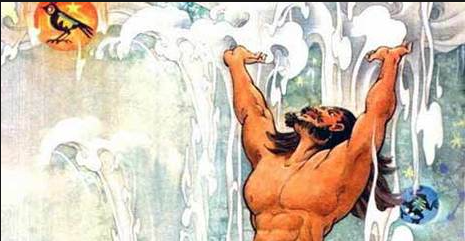
Historian Gu Jiegang proposed the theory of “the layered creation of ancient history.” The main idea of this theory is: First, in ancient historical records, “the further in time, the longer the legendary periods of ancient history.” In other words, the sequence and order of historical events often appear inverted. For example, in the Zhou Dynasty, the oldest person was considered to be Dayu, while by the time of Confucius, figures like Yao and Shun were revered. In the Warring States period, the Yellow Emperor and Shennong appeared, and only during the Qin Dynasty did the Three Sovereigns emerge. It wasn’t until the Han Dynasty that Pangu was mentioned. Therefore, the image of Pangu was actually first created by Xu Zheng, the Grand Minister of Eastern Wu during the Three Kingdoms period. In his works Three Five Calendar and Five Circulations of Years, Xu Zheng recorded the image and deeds of Pangu, establishing him as the creator god of Chinese mythology.
Secondly, Gu Jiegang believed that as time progressed, legendary figures grew larger in their roles. For example, Shun, who was merely seen as a sage ruler in Confucius’s time, was later seen as a model of filial piety in the time of Mencius. In other words, as time passed, the image of a historical figure would be expanded and enriched. Pangu was no exception. With the increased cultural exchange between the north and south during the Spring and Autumn and Warring States periods, and the integration of different ethnic groups, the Pangu legend, originally about a tribal ancestor, began to merge with the Chinese creation myth, and Pangu’s role as the creator god was continually strengthened. Works like Classic of Mountains and Seas and Zhuangzi from the pre-Qin period describe mythical figures like “Zhu Long” and “Hun Dun,” which bear similarities to Pangu. The Six Secret Teachings also contains brief records of Pangu being worshipped as a deity. In the Qin and Han periods, certain texts began to show early ideas resembling the concept of Pangu creating the world, such as Huainanzi, which describes the chaotic state before the formation of heaven and earth and the process of their creation—similar to the notion of Pangu separating heaven and earth from chaos. By the Three Kingdoms period, Xu Zheng incorporated the southern Pangu myth into the central cultural system, shaping a complete image of Pangu as the creator of heaven and earth, and the one who gave life to all things.
Therefore, over time and through cultural transmission, new cultural elements, such as “separating heaven and earth” and “transforming the body into all things,” were added to the original myth. Eventually, “Pangu” transformed from a tribal deity into the creation god of the Chinese nation.
Additionally, the spread of the Pangu myth was also propelled by folk beliefs and religion. Daoism revered Pangu as “Yuan Shi Tian Zun” (The Primordial Heavenly Lord) and included him in its pantheon of deities, elevating his religious status. In folk traditions, Pangu was worshipped as “Pangu Da Di” (Great Emperor Pangu), and temples were built to honor him, with various regions holding ritual ceremonies, further expanding the influence of the Pangu myth.
In conclusion, the evolution of the Pangu myth—from an ancient legend among southern minority ethnic groups to a common creation myth of the Chinese people—witnesses the development of Chinese civilization in a multi-ethnic and unified direction. Pangu’s act of creating heaven and earth is not only a romantic imagination of the origin of the universe but also a vivid reflection of the Chinese people’s pioneering and innovative spirit.