

Imagine cranking the volume to infinity. Could sound just keep getting louder forever?
No. Earth’s atmosphere enforces a strict, unbreakable limit: around 194 decibels, Maximum Loudness on Earth. Beyond that point, what we call “sound” ceases to exist in its normal form — and the physics turns violent.
This isn’t an arbitrary number or a measurement quirk. It’s a fundamental boundary dictated by the air we breathe. And when real events smash against it, the results are cataclysmic.
The Physics Behind the Limit: Why 194 dB Is the Hard Cap
Sound travels as pressure waves — rapid alternations between compression (high pressure) and rarefaction (low pressure) pushing through the atmosphere.
Under normal conditions, these oscillations center around everyday air pressure (about 101 kPa at sea level). Louder sounds mean bigger swings: stronger compressions and deeper rarefactions.
But pressure can’t drop below zero. Zero pressure equals vacuum — no air molecules left to vibrate.
At precisely 194 dB (calculated from 1 atm reference pressure), the rarefaction phase hits absolute vacuum during each cycle. You can’t pull the air “more empty” than nothing. The waveform flattens at the bottom, and any additional energy distorts the wave into something else entirely: a shock wave.
This is the theoretical maximum for undistorted, linear sound in Earth’s atmosphere. Push harder, and physics refuses to play nice.
Crossing the Line: When Sound Becomes a Weapon
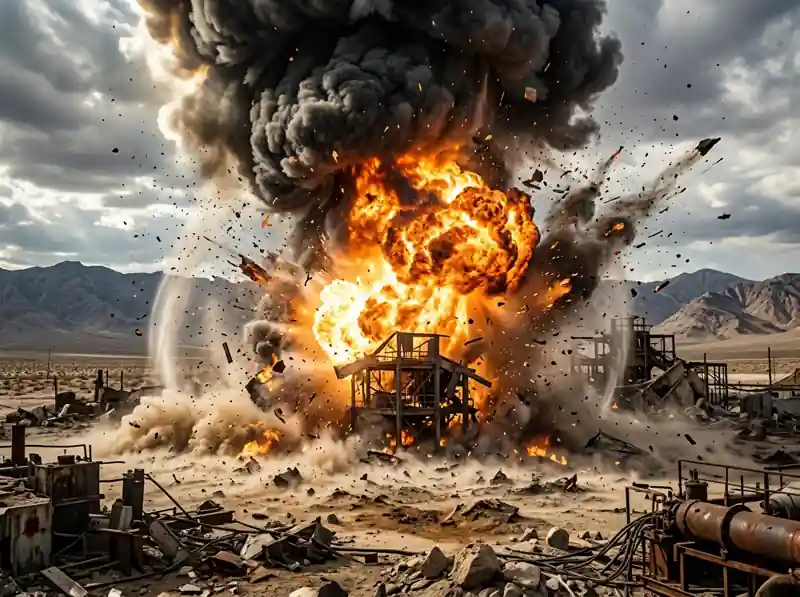
Once the 194 dB threshold is breached, the propagating disturbance is no longer a gentle pressure ripple. It forms a supersonic front of ultra-dense gas, trailed by near-vacuum regions. This shock front can pulverize buildings, superheat air on contact, and inflict lethal trauma — ruptured organs, shattered bones, instant death.
History gives us chilling examples.
Krakatoa 1883: The Planet’s Loudest Recorded Roar
The 1883 eruption of Krakatoa in Indonesia remains the benchmark for maximum loudness on Earth. The cataclysmic blast generated shock waves so intense that:
- Eardrums burst 40–50 km away
- Windows shattered and walls cracked over 160 km distant
- The acoustic pulse circled the globe 3–4 times, registering on barographs worldwide
Near the source, the energy exceeded 194 dB by a wide margin — not as sustained sound, but as a devastating overpressure wave equivalent to hundreds of decibels in raw power. It wasn’t “noise.” It was annihilation.
Human-Made Extremes: Rockets and Explosions
The Saturn V rocket launch hit around 203 dB at the pad — engineers pumped massive volumes of water underneath to dampen the acoustic assault and prevent structural failure.
Nuclear detonations go further still, creating instantaneous shock fronts that level cities and flash-heat air to ignition temperatures. These aren’t sounds you hear; they’re forces that destroy before your brain can register volume.
Putting Everyday Noise in Perspective
Decibels scale logarithmically — every +10 dB roughly doubles perceived loudness and multiplies intensity by 10×:
- Conversation: ~60 dB
- Motorcycle engine: ~100 dB
- Jet takeoff (nearby): 130–150 dB
- Pain threshold / immediate damage: ~130–140 dB
194 dB isn’t just “louder.” It’s millions to billions of times more intense than common noises. Crossing it shifts from annoyance to apocalypse.
The Limit Changes with the Medium
In water (denser than air), undistorted sounds can reach ~270 dB, as recent lab experiments using X-ray lasers have shown.
In the vacuum of space? Zero propagation — no medium, no sound. Even a supernova is silent.
If our planet had a much thicker atmosphere, the everyday roar of the Sun’s surface could theoretically hammer us with pressures approaching 290 dB equivalents. We’d never have developed ears at all.
A Philosophical Whisper at the End
If a massive explosion happens on a deserted island, does it produce “sound”?
It creates pressure waves, yes. But sound — as we experience it — requires perception. Without ears or instruments to interpret those waves, it’s just agitated molecules in an empty world.
The real wonder might not be the ceiling on loudness… but that we live in a universe quiet enough for us to notice any sound at all.
What would you do if you could safely witness something pushing right up against that 194 dB wall?
Further Reading:Does a Shadow Have Mass? Exploring If Shadows Have Physical Weight and Why We Can’t Weigh Them